Access to space has traditionally been expensive, technically complex and time-consuming. For companies developing new pharmaceuticals, advanced materials, semiconductors or biotechnology products, conducting experiments in microgravity can offer important scientific opportunities. However, organising a space mission usually requires specialised aerospace expertise, significant financial resources and lengthy preparation.
Vienna-based Tumbleweed is working to change this situation by developing infrastructure that allows researchers and industrial companies to conduct experiments in microgravity without having to build their own spacecraft or become aerospace specialists.
Founded in November 2024, the Austrian startup is developing modular laboratory containers and orbital platforms designed to make access to space more straightforward. Its approach combines standardised experiment containers, launch services and orbital operations into a single offering.
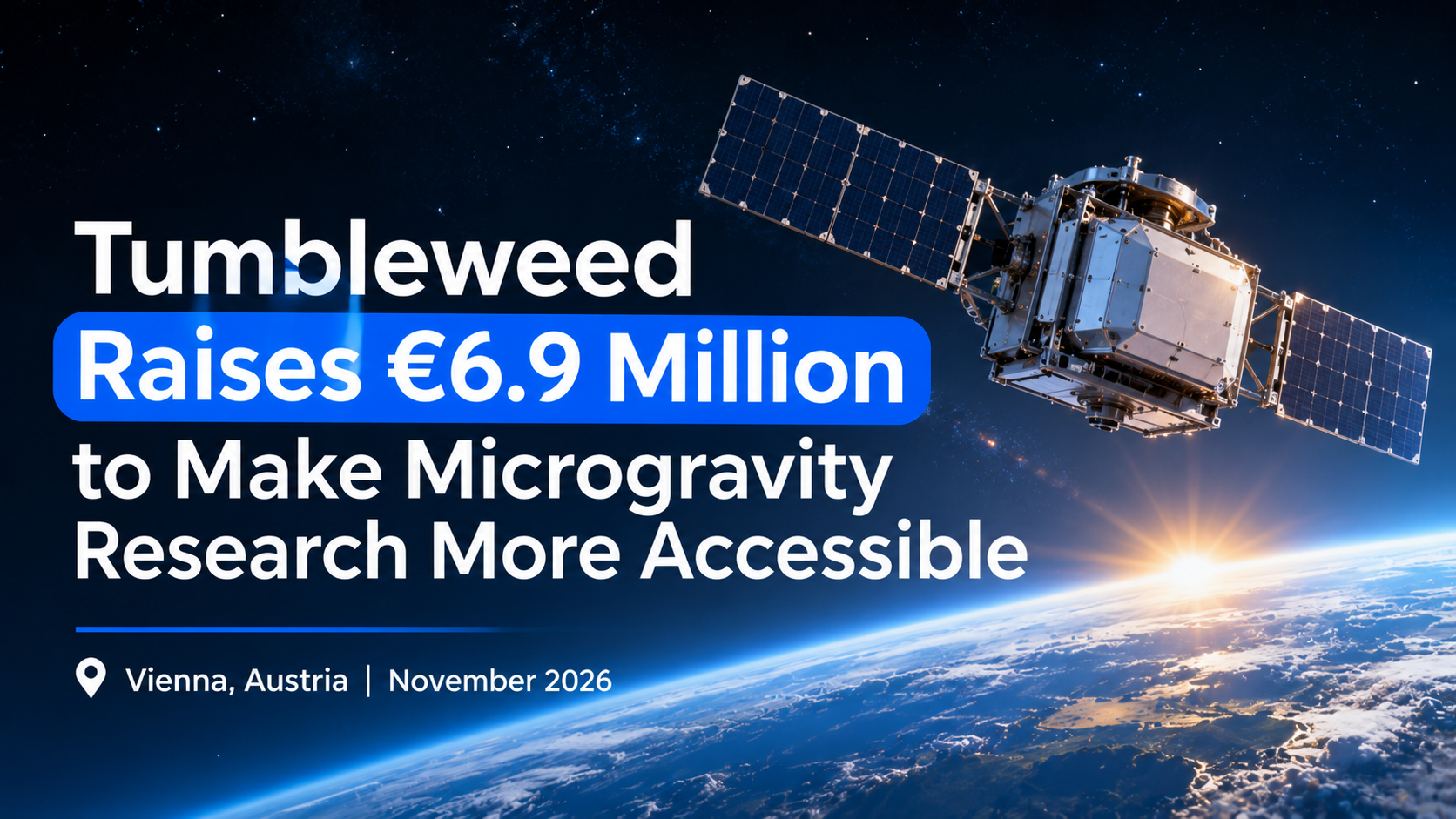
The company’s progress accelerated in July 2026, when its first spacecraft, Oasis Alpha, successfully reached orbit carrying experiments from four customers. Just four months later, in November 2026, Tumbleweed announced a €6.9 million seed investment to finance its next missions and develop a more advanced orbital platform.
The round is particularly significant for the Austrian ecosystem: it has been described as the largest SpaceTech seed financing round in the country’s history.
What this article covers
- Tumbleweed’s business model and the opportunities created by microgravity research.
- The €6.9 million seed investment announced in November 2026.
- The company’s investors, including the participation of its own employees.
- Its funding journey and the lessons it offers other European deep-tech entrepreneurs.
Making microgravity accessible as an industrial resource
Microgravity creates conditions that are difficult or impossible to reproduce on Earth. By reducing the effects of gravity, researchers can study physical and chemical processes in ways that may lead to new discoveries and improvements in industrial production.
Several sectors could benefit from these conditions:
- Pharmaceuticals: studying protein crystallisation and biological processes that could contribute to the development of new medicines.
- Biotechnology: investigating cellular behaviour and biological systems under different gravitational conditions.
- Semiconductors and photonics: exploring advanced materials and manufacturing processes.
- Advanced materials: studying how materials form and behave when gravitational forces have less influence.
Despite these opportunities, access to microgravity remains a major barrier for many research organisations and companies. Developing an independent space mission involves spacecraft engineering, launch arrangements, payload certification, mission operations and other specialised activities.
Tumbleweed’s business model is designed to remove much of this complexity.
Instead of requiring customers to develop their own aerospace capabilities, the company provides standardised infrastructure through which they can integrate experiments and send them into orbit.
Its ambition is to make access to space as straightforward as sending a package, opening up commercial opportunities for organisations that would otherwise struggle to conduct orbital research.
November 2026: €6.9 million seed investment to accelerate orbital missions
On 3 November 2026, Tumbleweed announced that it had raised €6.9 million in a seed financing round led by PactVC.
The investment is particularly significant for the Austrian startup ecosystem, as it has been described as the largest SpaceTech seed round in Austria’s history.
The round attracted several investors:
- PactVC: the lead investor, specialising in early-stage companies working in areas including planetary resilience, responsible AI and human potential.
- Vanagon Ventures: the Munich-based venture capital investor participating in the round.
- Prototype Capital: an existing early-stage investor continuing its support for the company.
- EWOR: an entrepreneurial investment platform supporting ambitious founders.
- International investors and business angels: additional private investors participating in the financing.
An especially interesting aspect of the transaction is the participation of Tumbleweed’s own employees. More than one-third of its 25-person team invested approximately €300,000 collectively in the company.
This represents an additional signal of internal commitment to the business and its long-term development. The employee contribution is included within the €6.9 million round, rather than being additional funding.
The investment will finance three main areas of development:
- Three orbital missions in 2027,
- Development of Oasis Beta,
- Expanding commercial operations.
The company’s funding announcement therefore represents more than a financial milestone: it provides the resources needed to move from an initial successful mission towards a repeatable commercial service.
Building a European microgravity infrastructure business
Tumbleweed’s ambition extends beyond launching individual satellites. Its longer-term objective is to make microgravity an accessible resource for industrial research and development.
The company believes that reducing the complexity and cost of space experiments could allow a wider range of businesses to integrate microgravity into their existing research processes.
This requires a combination of technological development, reliable launch access and the ability to support customers throughout the entire experimental process.
An important part of this strategy is the development of partnerships with launch providers.
In September 2026, Tumbleweed signed a memorandum of understanding with French rocket developer SIRIUS Space Services to explore the possibility of flying its Pod payload containers aboard SIRIUS launch vehicles.
The company also signed a strategic partnership with French launch developer HyPrSpace in June 2026 to explore dedicated European microgravity launch services.These partnerships are relevant because access to launch capacity is an important consideration for companies developing commercial space infrastructure. Working with several providers can offer greater flexibility when planning missions and responding to customer requirements.
Tumbleweed’s approach is to develop its own orbital technology while maintaining flexibility regarding the launch vehicles used to reach space.
This combination could help the company expand its operations without becoming dependent on a single launch provider.
What Tumbleweed’s funding journey shows
Tumbleweed’s development offers several valuable lessons for entrepreneurs working in SpaceTech, advanced engineering and other capital-intensive sectors.
Its experience is particularly interesting because it combines research-driven innovation, early customer engagement, private investment and the development of physical infrastructure.
- Identify a problem that exists beyond the technology itself.
Tumbleweed did not simply focus on building another satellite. Its founders identified the wider difficulties associated with accessing microgravity, including certification, integration, launch arrangements and operational support. By addressing the entire process, the company created a more accessible commercial proposition.
- Transform research and technical expertise into a business opportunity.
The founders’ earlier experience with the Team Tumbleweed Mars rover initiative helped them develop expertise and relationships within the space sector. However, the creation of the company in 2024 required a shift towards a more commercially actionable opportunity. Entrepreneurs working in research-intensive sectors should consider how their technical knowledge can address concrete customer needs.
- Validate demand before scaling infrastructure.
Oasis Alpha was fully booked a year before launch, and customers paid upfront. This provided evidence that organisations were willing to pay for access to microgravity. For hardware startups, securing early customers can help reduce uncertainty and strengthen the case for further investment.
- Develop products alongside customers.
Tumbleweed used successive prototypes and direct customer feedback to improve its Pod technology. This approach helped the company identify practical requirements before committing to a fully developed product. Entrepreneurs can benefit from involving early customers in product development, particularly when working with complex industrial technologies.
- Combine private investment with customer revenue.
The company’s model is not based exclusively on attracting investors. Paying customers helped validate the first mission, while the €6.9 million seed round provides capital to finance additional missions and more advanced technology. This combination can be particularly valuable for deep-tech businesses with significant development costs.
- Build a committed team and align incentives.
More than one-third of Tumbleweed’s employees invested approximately €300,000 collectively in the November round. This demonstrates a strong level of internal commitment and illustrates how employee participation can contribute to a company’s financing strategy.
- Use specialised investors to accelerate international development.
PactVC, Vanagon Ventures, Prototype Capital and EWOR bring experience in early-stage investment and technology entrepreneurship. For founders, selecting investors who understand the sector can be particularly important when commercialising complex technologies.
- Plan financing around technological milestones.
The €6.9 million round has clearly defined objectives: three missions in 2027 and the development of Oasis Beta for 2028. Linking funding requirements to measurable technical and commercial milestones can make a financing strategy more credible and help investors understand how their capital will contribute to growth.
Public and private funding: what entrepreneurs can learn
Tumbleweed’s November 2026 financing is a private seed investment led by PactVC, supported by other venture capital investors, international angels and employee participation.
Its founder’s earlier Mars exploration initiative also received support from the European Space Agency, as reported by Tech.eu. This was support for the original project and should be distinguished from the €6.9 million raised by the Tumbleweed company in November 2026.
For entrepreneurs developing technologies with substantial research and infrastructure requirements, this distinction is important.
Public funding can help finance research, technical validation and early innovation, while private investment can provide resources for commercialisation, manufacturing and international expansion.
Tumbleweed’s development illustrates why founders should consider different financing instruments according to their company’s maturity and objectives.
A research project may initially benefit from public innovation programmes, while a startup with a validated product, paying customers and a clear expansion strategy may be better positioned to attract venture capital.
The key is to build a funding strategy that reflects the company’s actual development needs rather than relying on a single financing source.
Fundingtrip: helping European entrepreneurs finance ambitious innovations
Tumbleweed’s journey demonstrates how innovative ideas can evolve into commercial businesses through a combination of technical expertise, customer validation and strategic financing. For entrepreneurs developing deep-tech, SpaceTech or other research-intensive innovations, understanding the European funding ecosystem can be essential to moving from the research stage to commercial growth.
At Fundingtrip, we help entrepreneurs understand public and private financing opportunities, identify relevant European programmes and develop the skills needed to prepare competitive funding applications. Our funding courses are designed to help founders navigate the funding landscape, build stronger proposals and identify the right financial resources to turn innovative ideas into successful businesses.
About the author of this post

.
Sara Gavidia
Content Creator
Communications Manager & Content creator
LinkedIn
[email protected]
.
Hello! I’m Sara 👋🏻
I’m FundingTrip’s Content creator. I write posts about technology, funding and innovation. If you liked this one, subscribe to our newsletter to receive more updates!
Post reviewed by David Arias, funding expert.