Artificial intelligence has made significant progress in language processing, image recognition and the automation of knowledge-based tasks. However, enabling machines to understand and operate reliably in complex physical environments remains a much more demanding challenge.
Autonomous systems need to interpret their surroundings, identify objects, understand spatial relationships and make decisions in real time. These requirements become particularly important in environments where conditions are unpredictable or satellite navigation is unavailable.
Munich-based SE3 is developing technology to address this challenge through spatial intelligence: the ability of machines to perceive, reason and act in three-dimensional environments.
The company combines computer vision and artificial intelligence to transform sensor data into a shared understanding of the physical world. Its software is designed to support autonomous systems, including drones and unmanned ground vehicles, operating in demanding environments.
Founded by researchers and engineers from the Technical University of Munich, SE3 is initially focusing on European defence applications, while identifying longer-term opportunities in robotics and civilian markets.
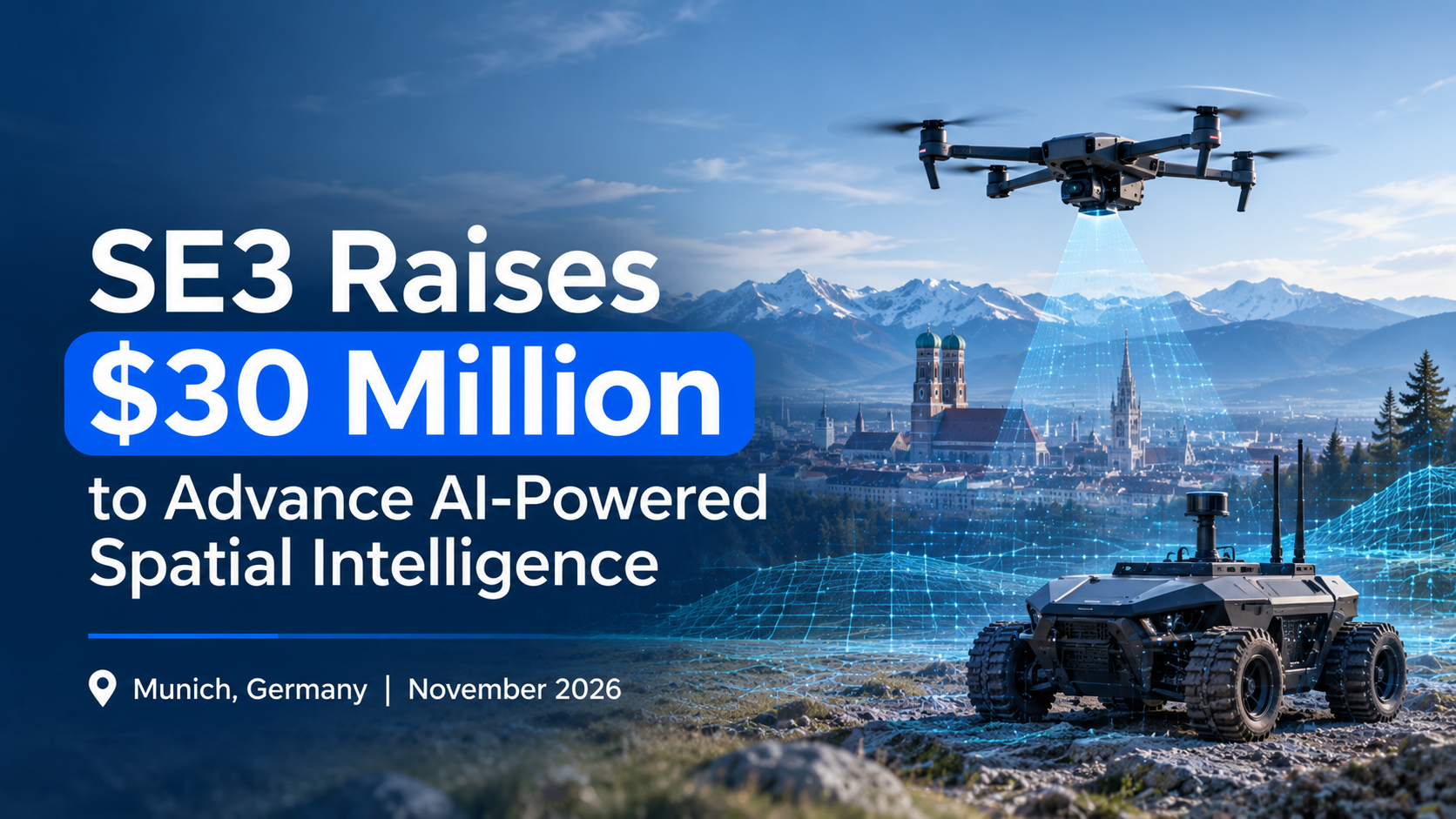
In November 2026, the company announced a $30 million Series A investment led by Accel, with participation from Keen, Lakestar and Seedcamp. The funding will support the expansion of its technical and commercial teams and accelerate its international development.
What this article covers
- SE3’s spatial intelligence technology and its applications.
- The company’s origins at the Technical University of Munich.
- Its focus on autonomous systems and European defence.
- The $30 million Series A investment announced in November 2026.
- Its earlier €5.5 million seed funding and investor network.
- What SE3’s funding journey shows about financing research-driven AI and defence technology companies.
What is spatial intelligence and why does it matter?
Most artificial intelligence applications operate primarily through digital information. Language models process text, image recognition systems analyse photographs and other AI applications identify patterns in large datasets.
Autonomous machines, however, must interact with the physical world.
A drone navigating an unfamiliar environment needs to understand its position, recognise obstacles, identify relevant objects and determine how to move safely. A group of autonomous vehicles may also need to share information so that several systems can operate together.
This is where spatial intelligence becomes important.
SE3 is developing a software layer that combines computer vision and AI to help autonomous systems interpret their surroundings and make decisions.
Its technology is designed to bring together information from different sensors and platforms, creating a shared three-dimensional representation of the environment.
This capability is particularly relevant when systems need to operate in conditions where satellite navigation signals are disrupted or unavailable.
Rather than depending exclusively on one manufacturer’s hardware or a single navigation system, SE3 is developing platform-agnostic software intended to integrate with different autonomous platforms.
The company describes its technology through several capabilities:
- Environmental perception: reconstructing and segmenting the surrounding environment using sensor information.
- Navigation without satellite positioning: supporting autonomous operations in environments where GNSS signals cannot be relied upon.
- Multi-platform coordination: helping one operator supervise multiple autonomous systems.
- Spatial understanding: enabling machines to interpret objects, obstacles and relationships in three-dimensional environments.
These capabilities are intended to make autonomous systems more reliable in demanding operational settings.
Defence as the initial commercial market
SE3’s immediate focus is on European defence, where autonomous systems are becoming increasingly important.
The growing use of drones and unmanned vehicles has created demand for software capable of supporting navigation, reconnaissance and coordination in complex environments.
For defence customers, autonomous systems must work reliably under pressure. They need to function when communications are limited, satellite navigation is disrupted or several platforms must coordinate their activities.
SE3 is developing its technology to address these requirements.
An important part of its strategy is its focus on software interoperability. Defence organisations often operate equipment from different manufacturers, making it difficult to integrate new capabilities across existing systems.
SE3’s platform-agnostic approach aims to provide a common intelligence layer that can work with different hardware platforms.
The company has already established relationships with several relevant industrial and defence technology organisations.
According to its November 2026 announcement, SE3 is working on multiple contracts with Ukraine and Germany’s armed forces, the Bundeswehr. It is also an AI partner to defence companies such as Rheinmetall and HENSOLDT, as well as technology businesses including Auterion and ERC System.
The company reported that it had shipped thousands of systems during the preceding two years.
These commercial and operational relationships are important because defence technology companies need to demonstrate that their products can perform in real environments, not just in laboratory testing.
Although defence is its immediate market, SE3 also sees potential applications in robotics, emergency response and other civilian settings where machines must operate autonomously in complex conditions. The company plans to explore these opportunities from 2027.
From university research to an autonomous systems company
SE3’s origins are closely connected to academic research.
The company was founded by Lukas Köstler, Simon Klenk and Professor Daniel Cremers, building on work conducted at the Technical University of Munich.
Köstler and Klenk were pursuing PhDs in computer vision and robotics at the university, while Cremers led the research group from which the company emerged.
This background is relevant because spatial intelligence requires advanced expertise in computer vision, robotics and artificial intelligence.The founders’ experience allowed them to work on a technically complex problem with applications extending beyond a single commercial product.The transition from university research to a company also reflects an important feature of the European deep-tech ecosystem: the potential to transform specialised academic knowledge into commercially relevant technologies.
However, moving from research to industrial deployment requires more than developing an effective algorithm. The company must build products that can operate reliably on real hardware, integrate with existing systems and meet the operational requirements of customers.
SE3’s defence relationships and reported deployments demonstrate its efforts to move from technological development towards practical adoption.
November 2026: $30 million Series A led by Accel
On 12 November 2026, SE3 announced that it had secured $30 million in Series A funding.
The round was led by Accel, with participation from Keen, Lakestar and Seedcamp.The investment represents a significant step in the company’s development and provides resources to expand its engineering, commercial and operational capabilities.
The funding will support several priorities:
- Recruiting additional engineering and technical personnel.
- Expanding commercial and operational teams.
- Strengthening the company’s presence in Germany and Ukraine.
- Opening an office in the United Kingdom.
- Supporting further expansion across Europe.
- Preparing the organisation to fulfil additional contracts.
The decision to raise a $30 million Series A reflects the company’s need to scale both its technological capabilities and its ability to serve customers.
In defence technology, commercial growth can involve long procurement processes, complex integration requirements and the need to demonstrate performance in operational conditions. Consequently, companies must be prepared to support customers beyond the initial development of their products.
Accel’s participation as lead investor is particularly relevant given the firm’s experience backing technology companies. The continued support of existing investors also provides continuity as SE3 moves into a new financing stage.
The round is private equity financing. It is not a public grant or government funding programme.
The earlier €5.5 million seed round
The November investment follows an earlier financing milestone.
In June 2026, SE3 Labs emerged from stealth with €5.5 million in seed funding, according to Munich Startup and subsequent reporting.
That round was led by Lakestar, with participation from Seedcamp, EWOR, the Sequoia Scout Fund, Plug and Play and TwinTrack.
The seed funding supported the development of the company’s spatial AI platform and its initial commercialisation activities.
It also provided an opportunity to move beyond the research stage and establish the company as a technology provider for autonomous systems.
The two financing rounds demonstrate a rapid progression from early-stage investment to a substantial Series A within the same year.
The investor structure is also notable. Lakestar and Seedcamp participated in the earlier round and continued supporting the company in November, while Accel led the Series A and Keen joined the investor group.
This combination of early-stage backing and new institutional capital can help provide both continuity and additional resources for international expansion.
What SE3’s funding journey shows
SE3 offers a relevant example of how research-intensive AI companies can move from academic development to significant private investment.
Its funding journey highlights several lessons for entrepreneurs.
- Academic research can create a strong technological foundation.
SE3 emerged from computer vision and robotics research at the Technical University of Munich. For founders working in deep tech, universities can provide access to specialised expertise, research infrastructure and talent.
- A clearly defined problem helps commercialise advanced technology.
Spatial intelligence is a broad technological concept, but SE3 has connected it to concrete requirements such as autonomous navigation, environmental perception and multi-platform coordination. Entrepreneurs should translate technical capabilities into practical problems that customers are willing to solve.
- A specialised initial market can provide a route to commercial validation.
SE3 has concentrated on European defence rather than attempting to serve every possible autonomous systems market from the beginning. This approach helps the company focus its product development and commercial relationships.
- Early investors can provide continuity across funding stages.
Lakestar and Seedcamp participated in both the seed and Series A financing. Building relationships with investors who understand the company’s technology and market can be valuable when raising subsequent rounds.
- Commercial traction matters alongside technical innovation.
The company’s reported contracts, industrial partnerships and deployment of thousands of systems provide evidence of progress beyond research and development. For deep-tech entrepreneurs, demonstrating customer adoption is essential when preparing for larger investment rounds.
- Public-sector markets require long-term planning.
Defence procurement can involve complex requirements and long sales cycles. Entrepreneurs targeting public-sector customers need to account for these timelines when planning their financing and operational development.
- Develop technology with opportunities beyond the first market.
Although SE3 is initially focused on defence, its underlying technology could also support robotics, emergency response and other civilian applications. A clear initial market combined with a credible longer-term expansion strategy can strengthen a company’s investment proposition.
For other entrepreneurs, SE3 demonstrates how a combination of academic research, early private investment, customer validation and a strong commercial focus can create the foundations for a substantial Series A round.
It also illustrates the importance of building a financing strategy that matches the complexity of the technology. Companies developing advanced AI and autonomous systems need capital not only to create their products but also to validate, integrate and deploy them in real-world environments.
Fundingtrip: supporting European deep-tech and AI entrepreneurs
SE3’s development illustrates the opportunities available to European innovators working at the intersection of research, artificial intelligence and industrial applications. However, turning advanced technology into a scalable company often requires a combination of public funding, private investment and strategic partnerships.
At Fundingtrip, we help entrepreneurs understand the European funding ecosystem, identify relevant grants and investment opportunities, and develop the skills needed to prepare competitive funding applications. If you are building an AI, robotics or deep-tech startup, our courses can help you understand how to finance research, validate your technology and prepare your company for its next stage of growth.
About the author of this post

.
Sara Gavidia
Content Creator
Communications Manager & Content creator
LinkedIn
[email protected]
.
Hello! I’m Sara 👋🏻
I’m FundingTrip’s Content creator. I write posts about technology, funding and innovation. If you liked this one, subscribe to our newsletter to receive more updates!
Post reviewed by David Arias, funding expert.