The protection of critical infrastructure has become an increasingly important challenge for governments, energy companies and industrial operators. Subsea cables, offshore installations, electricity networks and other essential assets face growing operational and security risks.
Monitoring these environments is particularly difficult because conventional sensing technologies can be limited by distance, electromagnetic interference, environmental conditions or the need for powered equipment at the sensing location.
Amsterdam-based Optics11 has developed a different approach using fibre-optic sensing technology. The company transforms light into a tool for detecting minute acoustic signals, enabling operators to monitor underwater environments and high-voltage electrical infrastructure.
Founded in 2011 as a spin-out from Vrije Universiteit Amsterdam, the company has spent more than a decade transforming scientific research into commercial products for industrial and security applications.
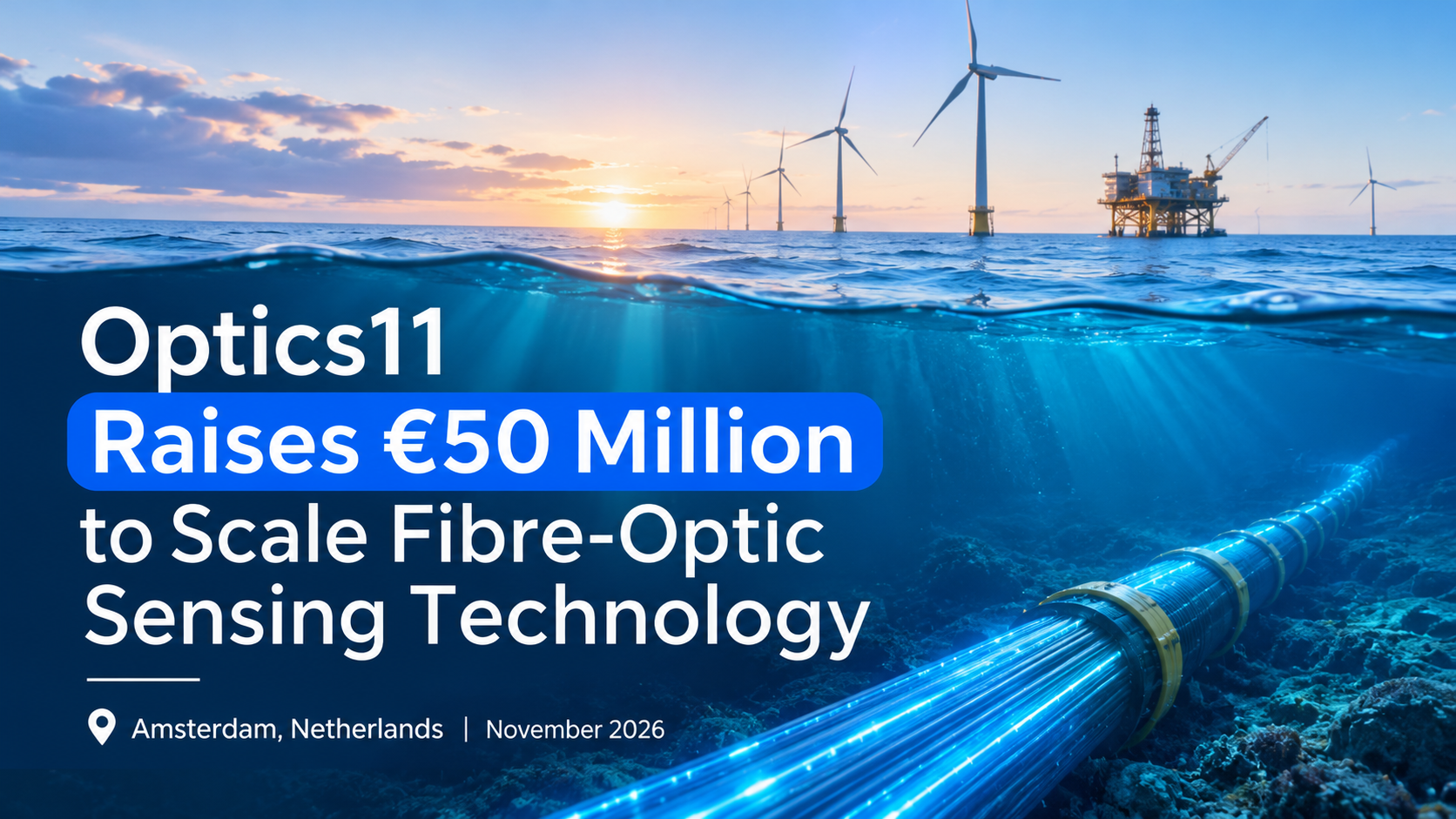
Its November 2026 funding announcement represents a major milestone in this development. Optics11 secured another €50 million in equity investment, bringing its total investment to more than €100 million over approximately 15 months.
The new capital is intended to increase manufacturing capacity, strengthen international operations and support the growing demand for its sensing solutions.
What this article covers
- Optics11’s technology and its main commercial applications.
- Its solutions for underwater security and energy infrastructure.
- The €50 million equity investment announced in November 2026.
- The investors participating in its latest financing round.
- The company’s recent funding trajectory and research origins.
- What its funding journey shows about financing deep-tech innovation.
How fibre-optic sensing addresses infrastructure challenges
Optics11 operates in a specialised area of deep technology: fibre-optic sensing.
The company’s technology uses optical fibres to capture acoustic signals and detect changes in the surrounding environment. Instead of relying on conventional powered electronic sensors at every sensing point, its systems use light to identify extremely small signals.
This approach provides several advantages in demanding environments. The sensing technology is immune to electromagnetic interference and can operate in locations where traditional monitoring systems face limitations.
Optics11 has developed two principal application areas: underwater security and energy grids.
Underwater intelligence
Underwater infrastructure is becoming increasingly important to energy supply, communications and national security. Subsea cables, ports, offshore installations and maritime assets require continuous monitoring, particularly as governments and infrastructure operators seek to improve their ability to detect potential threats.
Optics11’s underwater solutions include:
- OptiBarrier: a passive fibre-optic seabed sensing system designed to provide persistent monitoring around ports, subsea cables, offshore energy infrastructure and other maritime assets. The company reports detection and classification capabilities at distances of up to 100 kilometres from the shoreline.
- OptiArray: a fibre-optic towed array designed for underwater awareness, anti-submarine warfare and maritime surveillance.
These systems are intended to provide operators with information about underwater activity without relying on traditional active sensing methods.
An important development for the company came in 2026, when the Dutch Ministry of Defence selected its containerised OptiArray technology for the ASWINABO programme, or Anti-Submarine Warfare In A Box. This programme is intended to strengthen maritime surveillance capabilities and allow the technology to be deployed from different types of vessels, including uncrewed platforms.
Monitoring energy grids
The second major application area is electricity infrastructure.
As electricity demand increases and power networks become more complex, utilities and transmission operators need to identify potential equipment failures before they cause major disruptions.
Optics11 addresses this challenge through OptiFinder, a fibre-optic monitoring platform designed to detect and locate partial discharge in high-voltage electrical assets.
Partial discharge can be an early indicator of insulation deterioration and other electrical faults. Detecting these signals at an early stage can help operators identify developing problems and plan maintenance before equipment failure occurs.
The technology uses acoustic sensing to provide information about the location of potential faults, helping utilities and equipment manufacturers improve the monitoring of critical assets.
The company’s ability to serve both underwater security and energy infrastructure markets is an important aspect of its commercial strategy. Although these applications are different, they rely on the same underlying technological expertise: using fibre-optic systems to monitor environments where conventional sensing approaches may struggle.
November 2026: another €50 million in equity investment
On 9 November 2026, Optics11 announced that it had secured a further €50 million in follow-on equity investment.
The round was supported by four existing institutional investors:
- FORWARD.one
- Value Creation Capital
- SET Ventures
- JOIN Capital
All four investors participated again, reinforcing their support for the company’s next phase of international development.
The capital will be used to increase manufacturing capacity, expand operational capabilities and strengthen the company’s international presence.
This is particularly important for a deep-tech business whose growth depends on more than software distribution. Optics11 develops physical sensing systems that must be manufactured, integrated and deployed in demanding industrial and security environments.
As its customer base grows, the company needs to ensure that its production capacity and operational infrastructure can keep pace with demand.
The November investment is also connected to the growing commercial opportunities surrounding critical infrastructure protection. Governments are reassessing their maritime security capabilities, while electricity networks face increasing pressure from electrification and rising energy consumption.
Optics11 believes these developments are contributing to stronger demand for its technology across both business areas.
The €50 million is private equity investment. The company reported that total investment exceeded €100 million in approximately 15 months, highlighting the speed at which its financing requirements have increased alongside its commercial development.
A decade of research and commercial development
Optics11’s funding journey began long before its recent large investment rounds.
Founded in 2011, the company emerged from research conducted at Vrije Universiteit Amsterdam. Its origins demonstrate the potential of university research to generate technology with applications in industrial markets.
The commercialisation of deep technology often requires a longer development process than conventional software startups. Companies need to validate scientific principles, develop reliable hardware, test systems in real-world environments and build relationships with customers operating in highly specialised sectors.
For Optics11, this process has involved transforming photonics and acoustics research into sensing products that can be deployed in operational environments.
The company’s development has accelerated in recent years, particularly as the importance of underwater security and electricity grid resilience has increased.
The investment trajectory announced in November 2026 is especially notable: more than €100 million in total investment over approximately 15 months, including the latest €50 million round.
This level of financing reflects the capital requirements associated with scaling a deep-tech company that combines research, engineering, industrial production and international commercial operations.
It also demonstrates the role of repeat investment from existing shareholders. Rather than relying exclusively on new investors for every financing round, Optics11 has secured continued backing from institutions already familiar with its technology and development strategy.
What Optics11’s funding journey shows
The company’s experience provides several lessons for founders working on deep-tech, industrial and infrastructure-related innovations.
- University research can become the foundation of a scalable business.
Optics11’s origins at Vrije Universiteit Amsterdam demonstrate how scientific research can be translated into commercial technology. However, successful commercialisation requires a clear understanding of customer problems and the ability to move beyond laboratory validation.
- Deep-tech companies need financing strategies that reflect their capital requirements.
Developing sensing hardware, validating performance and increasing manufacturing capacity can require substantial investment. Entrepreneurs should plan financing around product development and operational milestones rather than assuming that a traditional software startup model will apply.
- A strong technology platform can serve several markets.
Optics11 uses the same underlying fibre-optic sensing capabilities across underwater security and energy grids. This creates opportunities to expand into related markets without having to build an entirely new technological foundation for every application.
- Public-sector demand can support commercial validation.
The selection of OptiArray for the Dutch Ministry of Defence’s ASWINABO programme provides an important example of how public procurement can create opportunities for deep-tech companies. Securing a government customer can also help demonstrate the relevance of a technology to other potential buyers.
- Existing investors can become strategic partners in scaling.
The participation of four existing investors in the latest round illustrates the value of maintaining relationships with shareholders throughout the development process. Investors who understand the technology and its market can support further growth.
- Commercial demand must be matched by production capacity.
The latest investment is directed partly towards manufacturing expansion. For hardware-based startups, winning customers is only one part of the challenge; the company must also be able to deliver its products reliably and at scale.
For entrepreneurs, Optics11 demonstrates that deep-tech funding is often a long-term process. Research funding, early commercial validation, institutional investment and large-scale equity rounds can play complementary roles in transforming a scientific innovation into an international business.
Fundingtrip: helping deep-tech entrepreneurs navigate public and private funding
Optics11’s journey illustrates why deep-tech companies need to understand the full range of financing opportunities available in Europe. Research grants, innovation programmes, public procurement and private equity can all contribute to different stages of commercial development.
At Fundingtrip, we help entrepreneurs understand these funding instruments and develop the skills needed to identify suitable opportunities, prepare applications and approach investors. Our courses are designed for founders who want to turn innovative technologies into sustainable businesses and build a financing strategy that supports long-term growth.
About the author of this post

.
Sara Gavidia
Content Creator
Communications Manager & Content creator
LinkedIn
[email protected]
.
Hello! I’m Sara 👋🏻
I’m FundingTrip’s Content creator. I write posts about technology, funding and innovation. If you liked this one, subscribe to our newsletter to receive more updates!
Post reviewed by David Arias, funding expert.