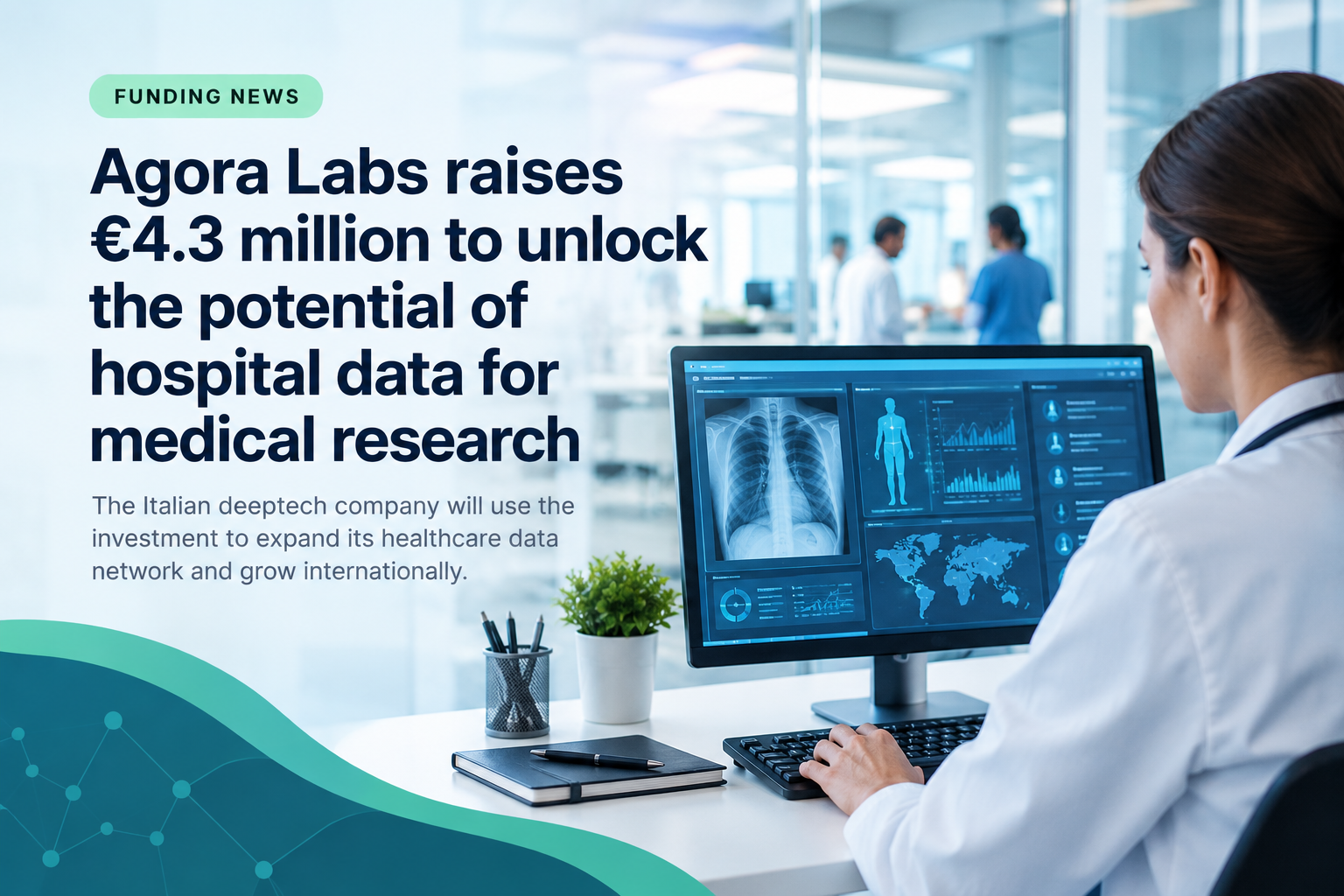
Italian deeptech company Agora Labs has raised €4.3 million in a funding round led by P101 to expand its healthcare data infrastructure and strengthen its international presence. Announced on 27 October 2026, the investment will support the company’s ambition to increase its network of participating healthcare facilities from 50 to 100 and expand its activities across Europe, the United States and other international markets.
Based in Rome, Agora Labs develops technology that allows hospitals to make their clinical data available for medical and scientific research while maintaining control over sensitive patient information.
Healthcare institutions generate enormous quantities of clinical information, but this data is frequently fragmented across different systems and formats. This can make it difficult for researchers, pharmaceutical companies and healthcare organisations to access the information needed for large-scale studies.
Agora Labs aims to address this problem through an infrastructure that allows data to be structured, standardised and analysed without requiring hospitals to transfer their underlying clinical information outside their own systems.
The company was founded by Davide Zaccagnini, a vascular surgeon and biomedical informatician trained at MIT, and Fabio Giulietto, an engineer with an MBA from Imperial College London.
Its business combines expertise in healthcare, data management and artificial intelligence to facilitate research based on real-world clinical information.
This article examines Agora Labs’ technology, its October 2026 investment, the investors supporting its development and the lessons its funding journey offers to entrepreneurs building deeptech solutions in healthcare.
What this article covers:
- Agora Labs’ approach to making hospital data available for medical research.
- Its technology for data standardisation, anonymisation and federated AI.
- The €4.3 million funding round announced in October 2026.
- The company’s international network and expansion plans.
- Lessons for entrepreneurs developing technology in regulated and data-intensive sectors.
Turning hospital data into a resource for medical research
Hospitals generate substantial amounts of information through everyday medical activities.
Patient records, diagnostic information, clinical histories and treatment outcomes can provide valuable evidence for scientific research and the development of new healthcare solutions.
However, this information is not always easy to use.
Different hospitals often rely on different information systems, data formats and internal processes. Clinical records may also contain unstructured information that requires considerable work before it can be used in research.
Privacy requirements introduce another important challenge. Medical information is highly sensitive, and healthcare institutions must ensure that research activities respect patient confidentiality and applicable data protection requirements.
Agora Labs has developed an infrastructure designed to address these challenges.
Its approach allows hospitals to organise and standardise their clinical data while keeping the underlying information within their own technological environments.
The objective is to make it possible for research institutions and pharmaceutical companies to conduct studies using information from multiple healthcare facilities without creating a central database containing identifiable patient records.
This model could help improve access to real-world clinical evidence, supporting research activities that require larger and more diverse patient populations.
How Agora Labs’ technology works
Agora Labs uses a combination of local computing infrastructure, specialised artificial intelligence models and federated data processing.
A dedicated computing node is installed at each participating healthcare facility. According to the company’s announcement, these nodes use NVIDIA GPUs to process clinical information locally.
The system performs several functions:
- Data structuring: specialised large language models help organise clinical information and convert unstructured records into more consistent formats.
- Data standardisation: information from different healthcare facilities is organised so that it can be used in multicentre research.
- Privacy protection: irreversible mathematical anonymisation processes are applied to protect patient information.
- Federated processing: data remains within the participating hospitals while algorithms allow information from different facilities to contribute to research.
- Federated learning: AI models can be trained and validated locally, with outputs and inferences shared instead of transferring the underlying patient records.
This architecture is based on an important principle: the clinical data remains within the hospital’s own infrastructure.
The company therefore aims to reduce one of the main barriers to collaborative healthcare research: the need to share sensitive patient information across institutions.
The infrastructure can support research projects involving hospitals, scientific organisations and pharmaceutical companies, including studies related to clinical outcomes, diagnostics and disease prevention.
Agora Labs raises €4.3 million in October 2026
On 27 October 2026, P101 announced that it had led a €4.3 million investment round in Agora Labs.
The financing also included participation from the Mussetto family, owners of Infinite Five, a holding company specialising in marketing technology, data analysis and robotics.
The investment will support the company’s next stage of development, with several priorities:
- Expanding its international healthcare network from 50 to 100 facilities.
- Strengthening its position in European and US markets.
- Entering additional international markets, including the Middle East and India.
- Expanding its technical and commercial teams, with around 20 additional professionals planned.
- Supporting the development and implementation of large-scale research projects.
The involvement of P101 is particularly relevant because the investor has experience supporting innovative companies through venture capital and operational development.
The financing also comes through investment programmes supported by European initiatives. P101 indicated that Programma 103 is supported by the European Union through the InvestEU Fund, while Programma 103R Digital receives support through CDP Venture Capital’s Digital Transition initiative under the NextGenerationEU framework.
It is important to distinguish these mechanisms from a direct grant to Agora Labs: the October transaction is an investment round led by a private venture capital firm, with participation from the Mussetto family. The European programmes support the investment vehicles involved.
An international network supporting healthcare research
One of Agora Labs’ most important assets is its network of participating healthcare institutions.
At the time of the October 2026 announcement, the company was working with 50 healthcare facilities internationally. Its objective is to double this number in the coming months.
The network is important because every additional hospital can increase the diversity and scale of clinical information available for research.
A multicentre approach can be particularly valuable when studying diseases, evaluating treatment outcomes or developing predictive models. Information from different hospitals and patient populations can help researchers investigate questions that may be difficult to address using data from a single institution.
Agora Labs has already supported research projects involving different types of clinical information.
In Italy, its infrastructure has enabled analyses of hospital pharmacy data and care pathways to compare different healthcare models.
In Saudi Arabia, a project is integrating genetic, clinical and radiological information to develop predictive models for complications associated with type 1 and type 2 diabetes. The objective is to support prevention and identify patients who may face higher risks.
These applications illustrate the potential of combining clinical data from different sources while maintaining control over the original information.
The funding journey behind Agora Labs
Agora Labs’ development began before the launch of its commercial operations.
The company emerged from a European research project focused on technologies for the secure sharing of clinical data. This work followed the introduction of the General Data Protection Regulation (GDPR) in 2018 and addressed the need to make healthcare information more accessible for research while protecting patient privacy.
The validation of the technology eventually led to the launch of commercial operations in 2023.
In January 2022, Agora Labs also received support from EIT Health through a support programme, according to its funding history. This provides an example of the role that European innovation ecosystems can play in the early development of healthcare technologies.
The October 2026 €4.3 million investment led by P101 represents a further step in its transition from technology development towards international commercial expansion.
The company’s progression highlights how research-driven businesses can use different forms of support at different stages: early innovation programmes, technology validation, commercial development and venture capital investment.
What Agora Labs’ funding journey shows
Agora Labs offers several important lessons for entrepreneurs working in deeptech, healthcare and other sectors where technology must address complex regulatory and operational requirements.
– Research can provide the foundation for commercial innovation. Agora Labs grew out of a European research project addressing a concrete problem in healthcare data management.
– Regulatory challenges can create opportunities for specialised technology. Data protection requirements are often seen as obstacles, but they can also generate demand for solutions that enable secure collaboration.
– Strong sector expertise can strengthen a deeptech proposition. The combination of medical, engineering and business expertise within the founding team is relevant to the complexity of its market.
– Networks can become a competitive advantage. Its international hospital network increases the potential value of the platform for research institutions and pharmaceutical companies.
– Public innovation programmes and private investment can complement one another. The company’s development illustrates how European support mechanisms and venture capital can contribute to different stages of an innovation journey.
– International expansion requires more than technological scalability. Establishing relationships with hospitals, healthcare providers and research organisations also requires trust, technical integration and an understanding of local requirements.
For entrepreneurs, Agora Labs demonstrates that building a successful deeptech company often involves a longer development process than launching a conventional software product.
Technology validation, regulatory considerations, partnerships and access to specialised customers can all influence the company’s ability to attract investment.
Its journey also highlights the importance of developing a business model around a problem that matters to several stakeholders. Agora Labs addresses the needs of hospitals, researchers and pharmaceutical companies, creating opportunities for a platform that can support different types of customers through a shared infrastructure.
How Fundingtrip can help entrepreneurs turn research into a funded business
Agora Labs’ journey demonstrates how research-driven innovation can evolve into a commercial opportunity with international potential. However, entrepreneurs working in deeptech and healthcare need to understand how to combine public support, private investment and strategic partnerships to finance their development. At Fundingtrip, we help founders identify funding opportunities, understand investment instruments and prepare their businesses for fundraising through practical training programmes. Learn more at Fundingtrip Courses.
About the author of this post

.
Sara Gavidia
Content Creator
Communications Manager & Content creator
LinkedIn
[email protected]
.
Hello! I’m Sara 👋🏻
I’m FundingTrip’s Content creator. I write posts about technology, funding and innovation. If you liked this one, subscribe to our newsletter to receive more updates!
Post reviewed by David Arias, funding expert.