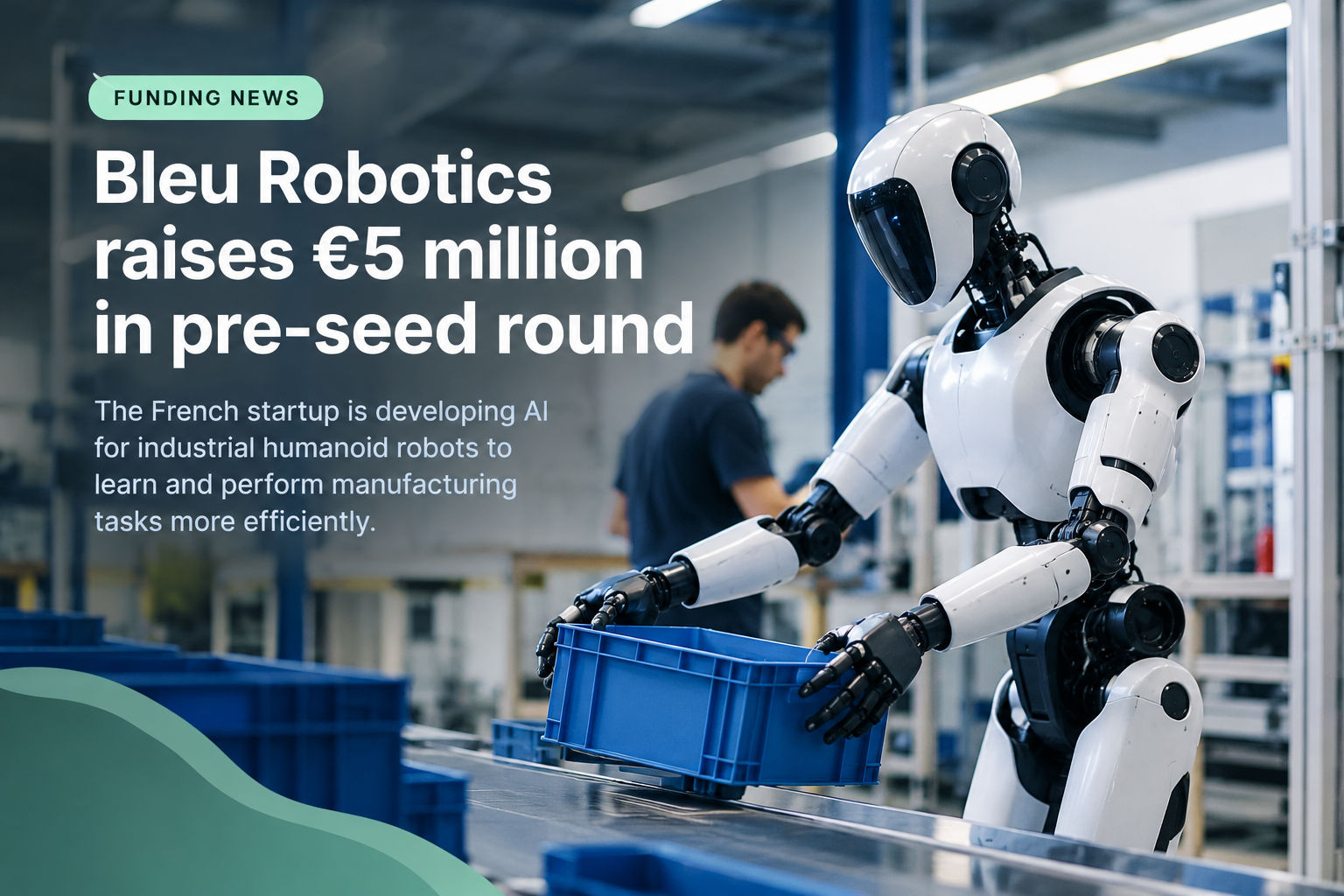
French startup Bleu Robotics has raised €5 million in a pre-seed funding round to develop artificial intelligence models that help industrial humanoid robots learn and perform manufacturing tasks more efficiently. Announced on 29 October 2026, the investment will support the company’s ambition to reduce the deployment process for industrial humanoid robots to one hour or less.
Based in Paris, Bleu Robotics is developing software designed to address one of the main challenges facing humanoid robotics: teaching robots to perform practical tasks in industrial environments without relying on enormous volumes of training data.
While much of the current development of artificial intelligence focuses on large datasets and increasingly general-purpose models, Bleu Robotics is pursuing a different approach. Its technology is designed around the specific requirements of manufacturing, where robots must learn tasks reliably and adapt to real production environments.
The company is targeting an important opportunity in industrial automation. Manufacturers are increasingly exploring how humanoid robots could help address labour shortages, improve production flexibility and support the relocation of industrial activity.
This article examines Bleu Robotics’ technology, its October 2026 pre-seed financing, the investors supporting its development and the lessons its funding journey offers to entrepreneurs working in deeptech and industrial innovation.
What this article covers:
- Bleu Robotics’ approach to AI-powered industrial humanoid robotics.
- The €5 million pre-seed round was announced in October 2026.
- The investors participating in the financing and its intended use.
- The opportunity for humanoid robotics in manufacturing.
- What the company’s early funding milestone shows about financing capital-intensive technologies.
Addressing the challenge of training industrial robots
Humanoid robotics is attracting increasing attention because of its potential to automate tasks in environments originally designed for people. Factories, warehouses and industrial facilities often contain equipment, workstations and production processes that require considerable flexibility.
However, deploying humanoid robots in these environments is not simply a matter of developing a machine capable of moving and interacting with objects. Robots must also understand how to perform specific tasks, respond to changing conditions and operate reliably within industrial workflows.
This is where Bleu Robotics aims to differentiate itself.
The Paris-based company is developing AI models for industrial humanoid robots, with a focus on making the training and deployment process more efficient. Its approach challenges the idea that industrial robotics must rely on millions of data points or fully general-purpose models to achieve useful results.
According to co-founder Benoît Berkoukchi, industrial manufacturing does not offer the enormous quantities of training data available in some other AI applications. Factory tasks are specialised, and collecting large datasets for every possible activity can be difficult.
Bleu Robotics therefore aims to achieve more with fewer demonstrations and more targeted training methodologies. Its ambition is to reduce the complete deployment process to one hour or less, potentially making humanoid automation more accessible to manufacturers.
€5 million pre-seed funding announced in October 2026
On 29 October 2026, Bleu Robotics announced that it had raised €5 million in a pre-seed financing round.
The investment was co-led by Contrarian Ventures and OVNI Capital, with participation from:
- Kvanted.
- WEPA Ventures.
- Motier Ventures.
- Charlie Songhurst.
- Board members at Meta.
The funding will support the development of the company’s AI technology and its ambition to make humanoid robot deployment faster and more practical for industrial customers.
The participation of several investors with different backgrounds is particularly relevant for an early-stage deeptech company. Robotics businesses often require a combination of technical expertise, industrial understanding and financial resources to move from research and development towards commercial deployment.
The involvement of Contrarian Ventures and OVNI Capital also places Bleu Robotics within a European investment landscape increasingly interested in physical AI, industrial automation and robotics software.
Why industrial humanoid robotics is attracting investment
The development of humanoid robots is closely connected to wider changes in manufacturing.
Industrial companies are looking for ways to improve productivity, respond to labour shortages and make production systems more adaptable. Traditional automation can be highly effective for repetitive activities, but it may require expensive infrastructure and specialised equipment when production processes change.
Humanoid robots could offer a different approach by operating in environments designed for human workers. Their potential applications include handling materials, carrying out repetitive manufacturing activities and supporting production processes that require flexible movement.
However, the commercial opportunity depends on more than the availability of advanced hardware. Manufacturers need robots that can be trained, deployed and maintained without excessive costs or lengthy integration processes.
Bleu Robotics is addressing this software challenge. By focusing on industrial tasks rather than attempting to create a universal model for every possible application, the company is positioning its technology around a specific commercial need.
The distinction is important. In industrial environments, performance, reliability and deployment time can be more relevant to customers than the ability to perform a wide variety of unrelated tasks.
What Bleu Robotics’ funding journey shows
Bleu Robotics’ €5 million pre-seed round offers several lessons for entrepreneurs developing early-stage deeptech companies.
– A specific technical problem can provide a strong starting point. Rather than addressing humanoid robotics as a broad concept, Bleu Robotics focuses on the difficulty of training robots for industrial tasks.
– Commercial relevance matters alongside technological ambition. Reducing deployment time to one hour or less gives the company a concrete objective connected to manufacturers’ operational needs.
– Early-stage investors can support technologies before they reach full commercial maturity. The pre-seed round provides resources to advance a technically demanding solution that still needs development and validation.
– Industrial expertise is essential in deeptech. Robotics companies need to understand the environments in which their technology will operate, not only the underlying AI models.
– A strong investor group can bring more than capital. Different investors can provide access to industrial networks, technical expertise and potential commercial relationships.
For entrepreneurs, Bleu Robotics illustrates the importance of connecting a complex technology with a clearly identifiable market problem. Deeptech businesses often require substantial investment before their products are ready for widespread adoption. Explaining what the technology solves, why existing approaches are insufficient and how the solution can be deployed commercially is therefore essential when approaching investors.
The company’s next challenge will be to demonstrate that its approach can deliver measurable results in real industrial environments. Successful validation could strengthen its position in a rapidly developing robotics market.
How Fundingtrip can help entrepreneurs finance deeptech innovation
Bleu Robotics demonstrates how an early-stage company can build an investment proposition around a specialised technological challenge with significant industrial potential. For entrepreneurs developing robotics, AI or other deeptech solutions, understanding how to approach investors and identify suitable funding opportunities is essential. Fundingtrip offers practical courses to help founders prepare their funding strategies, understand financing instruments and develop stronger investment proposals. Discover our programmes at Fundingtrip Courses.
About the author of this post

.
Sara Gavidia
Content Creator
Communications Manager & Content creator
LinkedIn
[email protected]
.
Hello! I’m Sara 👋🏻
I’m FundingTrip’s Content creator. I write posts about technology, funding and innovation. If you liked this one, subscribe to our newsletter to receive more updates!
Post reviewed by David Arias, funding expert.