Osavul began in Ukraine in 2022, in response to the full-scale Russian invasion and the growing need to detect and counter information threats. The company has since developed its technology beyond disinformation monitoring into a broader form of hybrid risk intelligence covering information, cyber and physical threats.
The company’s AI platform is designed to identify hostile activity and intent before threats materialise. Its customer base includes government and defence institutions, and Osavul says its technology is used by NATO and organisations across more than ten countries.
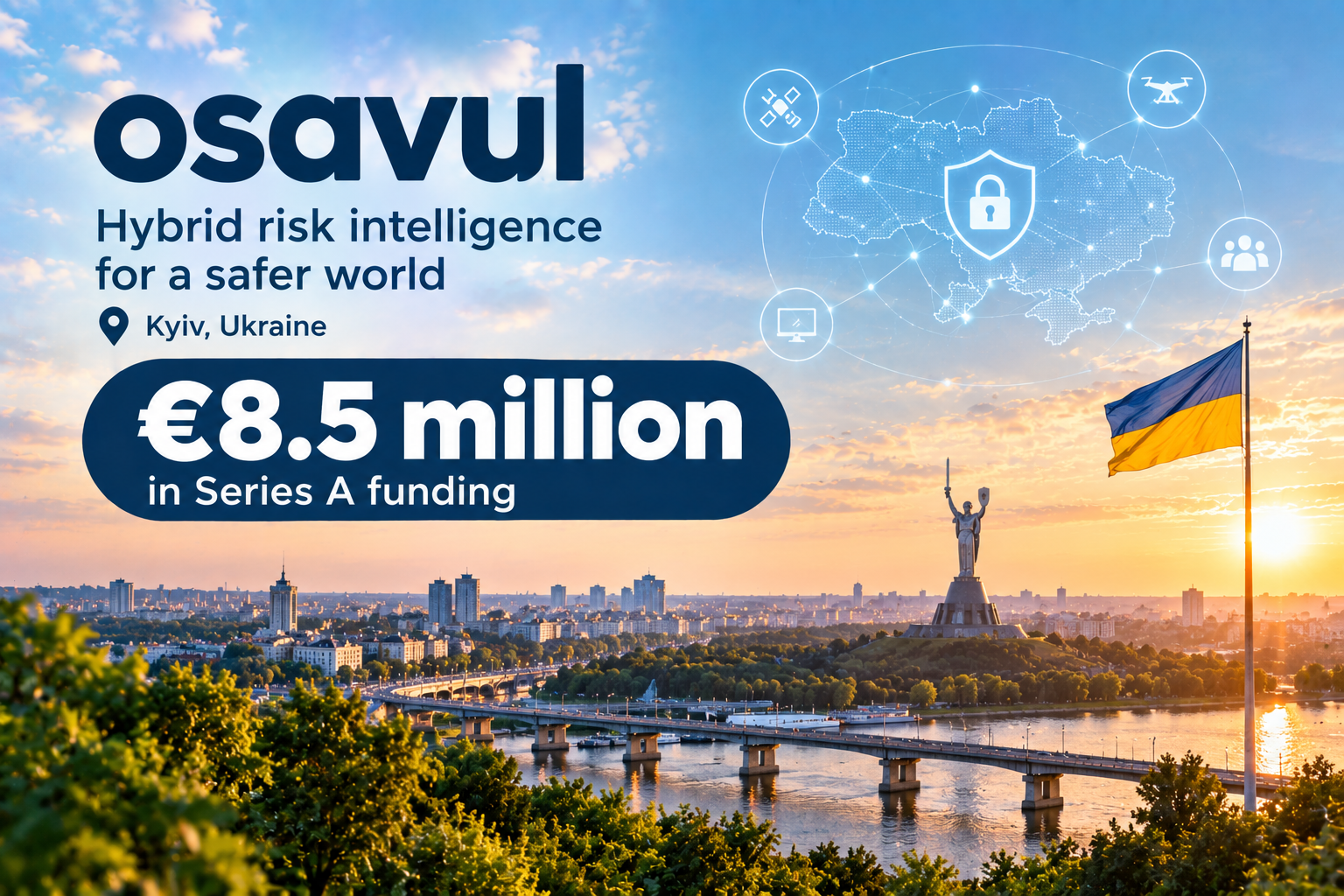
In October 2026, the company announced its most significant financing milestone to date: an €8.5 million Series A, bringing its total funding to approximately €12 million.
What this article covers
- How Osavul evolved from an anti-disinformation startup
- Its early private and public-backed funding
- The €8.5 million Series A announced in October 2026
- The company’s expansion from government and defence into commercial infrastructure
- What the funding journey shows about security and deep-tech entrepreneurship
From disinformation to hybrid risk
Osavul was founded by Dmytro Plieshakov and Dmytro Bilash in 2022. Its initial focus was information security and the detection of disinformation and information operations.
The company developed AI-based tools capable of analysing information from different digital sources and identifying hostile narratives, actors and campaigns.
Over time, Osavul expanded this proposition into hybrid risk intelligence. Its current platform brings together information, cyber and physical risk rather than treating these areas as completely separate problems.
This evolution reflects the changing nature of security threats. Organisations may face coordinated activity across several channels at the same time, creating a need for a broader picture of risk.
Building the funding base
Osavul’s financing journey started with Ukrainian venture capital.
In 2023, the company raised $1 million from SMRK, supporting technology development and international expansion.
In September 2024, Osavul raised a further $3 million from 42CAP, u.ventures and SMRK in a late-seed round. The company said the financing would support international expansion, new B2B solutions and improvements to its AI capabilities.
Public and non-dilutive support has also formed part of the company’s journey. Dealroom records a $100,000 grant from 1991 Ventures and the Google for Startups Ukraine Support Fund in 2024, followed by a €500,000 European Innovation Council grant in 2025.
This combination is significant for a Ukrainian technology company operating in security. Venture funding provides commercial capital, while grants and public programmes can support technology development and internationalisation without relying exclusively on equity financing.
October 2026: €8.5 million Series A
On 1 October 2026, Osavul announced an €8.5 million Series A led by 33N Ventures, with participation from Balnord, Giesecke+Devrient Ventures and existing investor 42CAP.
The round brings Osavul’s total funding to approximately €12 million.
The new capital is intended to accelerate the company’s international growth and expand its customer base beyond government and defence. Osavul is specifically targeting enterprises and critical infrastructure operators while continuing to develop its government and defence business.
The company says its technology is already deployed in more than ten countries and that its total contract value increased significantly during 2025.
This creates an important transition in the company’s story. Its technology was initially shaped by an urgent national-security problem and validated in highly demanding environments. The next stage is to determine how successfully that capability can be translated into a broader international commercial market.
What Osavul’s funding journey shows
Real-world problems can create strong technology validation.
Osavul emerged from an immediate security need and developed its technology in an unusually demanding environment.
Early local investors can provide the foundation for international growth.
SMRK backed the company more than once, while later rounds brought in European investors such as 42CAP.
Public funding can complement venture capital.
Grants from European and Ukrainian-related programmes have supported the company’s development alongside private investment.
A strong initial market can provide a route into larger markets.
Osavul is using experience with government and defence customers to expand toward enterprises and critical infrastructure.
The funding journey can follow the evolution of the product itself.
The company moved from information security and disinformation toward a wider hybrid risk intelligence platform.
What this means for entrepreneurs
Osavul provides a useful example for founders building cybersecurity, defence or other technologies where trust and validation are particularly important.
For these companies, customer credibility can be as important as product development. Demonstrating that technology can operate in demanding environments can help establish the foundation for later commercial expansion.
Its funding path also illustrates the value of not treating grants and private investment as competing alternatives. Early grants can help develop technology and demonstrate feasibility, while equity investors can provide the resources required for international commercialisation.
For entrepreneurs in similar sectors, the central lesson is to build financing around evidence: technical performance, trusted customers, measurable commercial traction and a clear route into larger markets. Fundingtrip’s funding courses can help founders understand how to build that financing roadmap and identify the right opportunities for each stage.
About the author of this post

.
Sara Gavidia
Content Creator
Communications Manager & Content creator
LinkedIn
[email protected]
.
Hello! I’m Sara 👋🏻
I’m FundingTrip’s Content creator. I write posts about technology, funding and innovation. If you liked this one, subscribe to our newsletter to receive more updates!
Post reviewed by David Arias, funding expert.