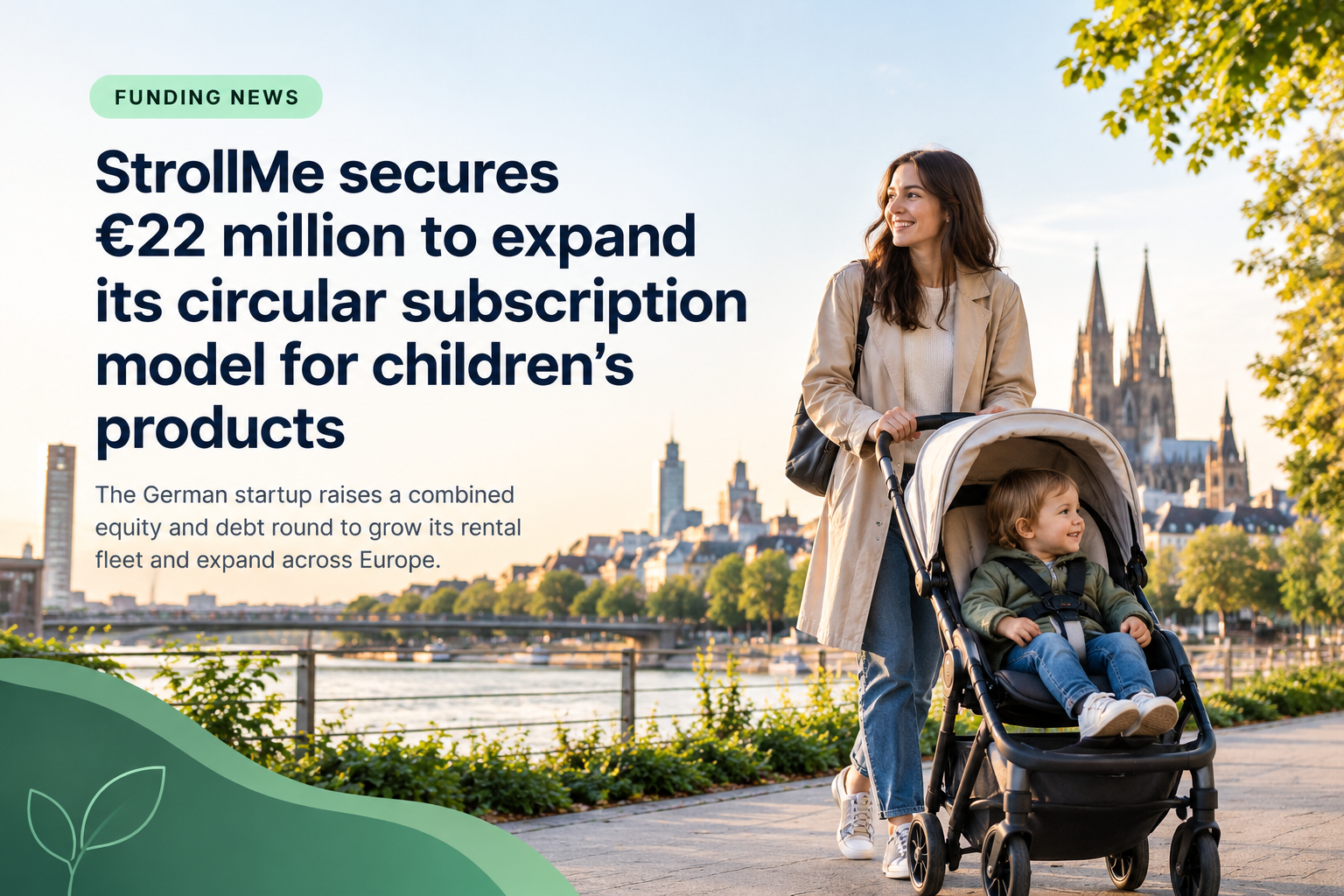
German startup StrollMe has secured €22 million in combined equity and debt financing to expand its subscription-based business for children’s mobility products and strengthen its position in European markets. Announced on 29 October 2026, the financing will allow the company to increase its rental fleet, broaden its product offering and prepare for expansion into additional European countries.
Based in Frankfurt, StrollMe offers families an alternative to purchasing children’s products outright. Through its subscription model, customers can rent products such as children’s bicycles, balance bikes, strollers and car seats, with the flexibility to change products as their children grow.
The company’s approach addresses a practical challenge for families: many children’s products are relatively expensive, yet they may only be needed for a limited period. Traditional ownership can therefore involve significant costs and products that quickly become unsuitable.
StrollMe has built its business around extending the useful life of these products. After a subscription ends, products are refurbished and made available to other customers. Its sister brand, Kiddly, also sells refurbished products after their rental lifecycle.
The company operates in Germany, Austria and the Netherlands. It has completed more than 100,000 rental transactions, while reporting revenue growth of approximately 70% in 2025.
This article examines StrollMe’s business model, its October 2026 financing, the investors supporting its growth and the lessons its funding journey offers to entrepreneurs developing subscription-based and circular business models.
What this article covers:
- StrollMe’s subscription model and its approach to children’s mobility products.
- The €22 million financing announced in October 2026.
- The private investors and debt provider participating in the transaction.
- The company’s previous funding activity and commercial development.
- What its funding journey shows about financing inventory-intensive and circular businesses.
Making children’s products accessible through subscriptions
StrollMe is built around a relatively simple idea: families should not necessarily have to purchase every product their children need.
Children grow quickly, and products such as bicycles, strollers and car seats often have a limited period of use for an individual family. Buying these products can represent a significant expense, particularly when families need to replace them as their children grow.
StrollMe offers a subscription alternative that gives customers access to different products without requiring permanent ownership.
The business model also incorporates the management of products after their first rental period. Rather than treating returned products as waste or selling them immediately at a discount, StrollMe refurbishes them and prepares them for another subscription. This creates a system in which the same product can generate value across several customer relationships.
The approach has two important dimensions.
First, it provides convenience and flexibility to families, allowing them to adapt their product choices to changing needs.
Second, it supports a more circular approach to consumption by extending the useful life of products and reducing the need for every customer to purchase new equipment.
The company’s sister brand, Kiddly, complements this model by selling refurbished products after their rental lifecycle, providing another channel through which products can continue to be used.
StrollMe raises €22 million in October 2026
On 29 October 2026, StrollMe announced that it had secured €22 million in a financing package combining equity and debt.
The transaction brought together existing investors and new financial partners.
The participating investors included:
- Hanse Ventures: an existing investor continuing its support for the company.
- HGDF: another returning investor.
- JOSS: participating again in the financing.
- Kristina Schreiner: business angel associated with the better ventures network.
- BMH Beteiligungs-Managementgesellschaft Hessen mbH: a new equity investor participating through its Hessen Kapital I fund.
- Growth Credit Partners (GCP): the provider of the credit facility included in the financing package.
The combination of equity and debt is particularly relevant to StrollMe’s business model.
Equity investment provides additional capital to support the company’s development, while the credit facility offers debt financing that can help fund its operational requirements. The company has not publicly specified how the €22 million is divided between these two components.
The funding will support several priorities:
- Expanding the rental fleet to make more products available.
- Broadening the range of children’s products offered through subscriptions.
- Improving availability of popular models.
- Supporting growth in Germany, Austria and the Netherlands.
- Preparing the foundations for expansion into other European markets.
The financing responds to an operational challenge identified by the company: demand for popular products has sometimes exceeded availability. Increasing the size of its fleet is therefore important not only for geographical expansion but also for serving existing customers more effectively.
Previous investment and the development of StrollMe
The October 2026 transaction builds on previous financial support from investors who have accompanied the company’s development.
StrollMe’s earlier funding history includes an initial investment from Hanse Ventures in 2021 and a €3.6 million seed round recorded in November 2023. Hanse Ventures and HGDF Familienholding were among the investors involved in that earlier financing.
These earlier investments supported the development of the subscription business before the company reached its current expansion phase.
The October 2026 financing is different in scale and structure. It combines renewed support from existing investors with the participation of BMH as a new equity investor and Growth Credit Partners as a debt provider.
This evolution is relevant because StrollMe’s operational requirements increase as its subscription business grows.
Unlike a software company that can potentially serve additional customers without a comparable increase in physical assets, a rental business must maintain sufficient inventory to meet demand.
Every additional subscription requires the company to manage product availability, refurbishment, logistics and the movement of products between customers.
The financing therefore addresses a central requirement of the company’s growth model: ensuring that its fleet expands alongside customer demand.
The operational challenge behind circular subscription businesses
StrollMe’s business model illustrates both the opportunities and the financial complexities of the circular economy.
Subscription services can create recurring customer relationships and provide more predictable revenue than individual product sales. They can also increase the value generated by each physical asset by allowing it to be used by several customers over time.
However, these advantages come with operational requirements.
Companies must finance the acquisition of products, maintain sufficient inventory, manage returns, refurbish equipment and ensure that products remain suitable for subsequent customers.
The economics of the model therefore depend on how efficiently companies manage the entire product lifecycle.
StrollMe’s reported growth of approximately 70% in 2025, together with its more than 100,000 rental transactions, provides an indication of the commercial development behind its latest financing. The company’s decision to increase its fleet reflects the need to match its physical capacity with growing demand.
What StrollMe’s funding journey shows
StrollMe offers several lessons for entrepreneurs developing subscription businesses, marketplaces and circular economy solutions.
– A business model should solve a recognisable customer problem. StrollMe addresses the cost and inconvenience of purchasing products that children may only use for a relatively short period.
– Circular business models need operational infrastructure. Reusing and refurbishing products creates opportunities, but requires investment in logistics, inventory management and quality control.
– Growth can create new financing requirements. As demand increases, companies with physical assets may need additional working capital and investment in inventory to maintain service quality.
– Equity and debt can serve complementary purposes. StrollMe’s October financing combines investors providing equity with a specialist credit provider, demonstrating how different financing instruments can support different business needs.
– Existing investor relationships can help support later growth. The participation of returning investors alongside a new equity investor demonstrates the importance of building confidence throughout a company’s development.
For entrepreneurs, StrollMe highlights an important point: the financial needs of a startup depend heavily on its business model.
A subscription company managing physical products has different capital requirements from a software-as-a-service business. Founders need to understand these differences when preparing financial projections, calculating working capital needs and deciding whether equity, debt or a combination of both is appropriate.
The company’s journey also shows how sustainability and commercial viability can reinforce one another when a circular model is designed around a genuine customer need.
How Fundingtrip can help entrepreneurs finance their business models
StrollMe’s experience demonstrates that innovative business models require carefully planned financing strategies, particularly when growth depends on physical assets, inventory and logistics. Entrepreneurs need to understand which funding instruments are suitable for their operations and how to present their business potential to investors. Fundingtrip helps founders develop these skills through practical courses covering fundraising, investor preparation and funding opportunities. Discover our programmes at Fundingtrip Courses.
About the author of this post

.
Sara Gavidia
Content Creator
Communications Manager & Content creator
LinkedIn
[email protected]
.
Hello! I’m Sara 👋🏻
I’m FundingTrip’s Content creator. I write posts about technology, funding and innovation. If you liked this one, subscribe to our newsletter to receive more updates!
Post reviewed by David Arias, funding expert.