Paris-based Primo develops an integrated platform for managing corporate IT. The company brings together device management, SaaS applications, employee identities, hardware procurement and IT support in one system.
Founded in 2022 by Martin Pannier, Antoine de Mereuil and Nicolas Nallet, Primo initially focused on simplifying IT management for growing companies. Its platform has since expanded towards AI agents capable of executing IT processes rather than simply providing information or recommendations.
Primo says more than 400 companies across ten countries use the platform. Its customers include startups, scaleups and SMEs, and the company reported annual recurring revenue of more than €3.4 million in September 2026.
This post covers:
- What Primo does
- Its 2023 and September 2026 funding rounds
- Its move from IT management to AI-powered execution
- What its funding journey can teach entrepreneurs
The funding journey
Primo’s first major financing was announced alongside its launch in 2023, when the company raised approximately $3.4 million in seed funding from Headline and Global Founders Capital.
The company then spent the following years building a unified IT platform covering devices, applications, access and employee lifecycle processes.
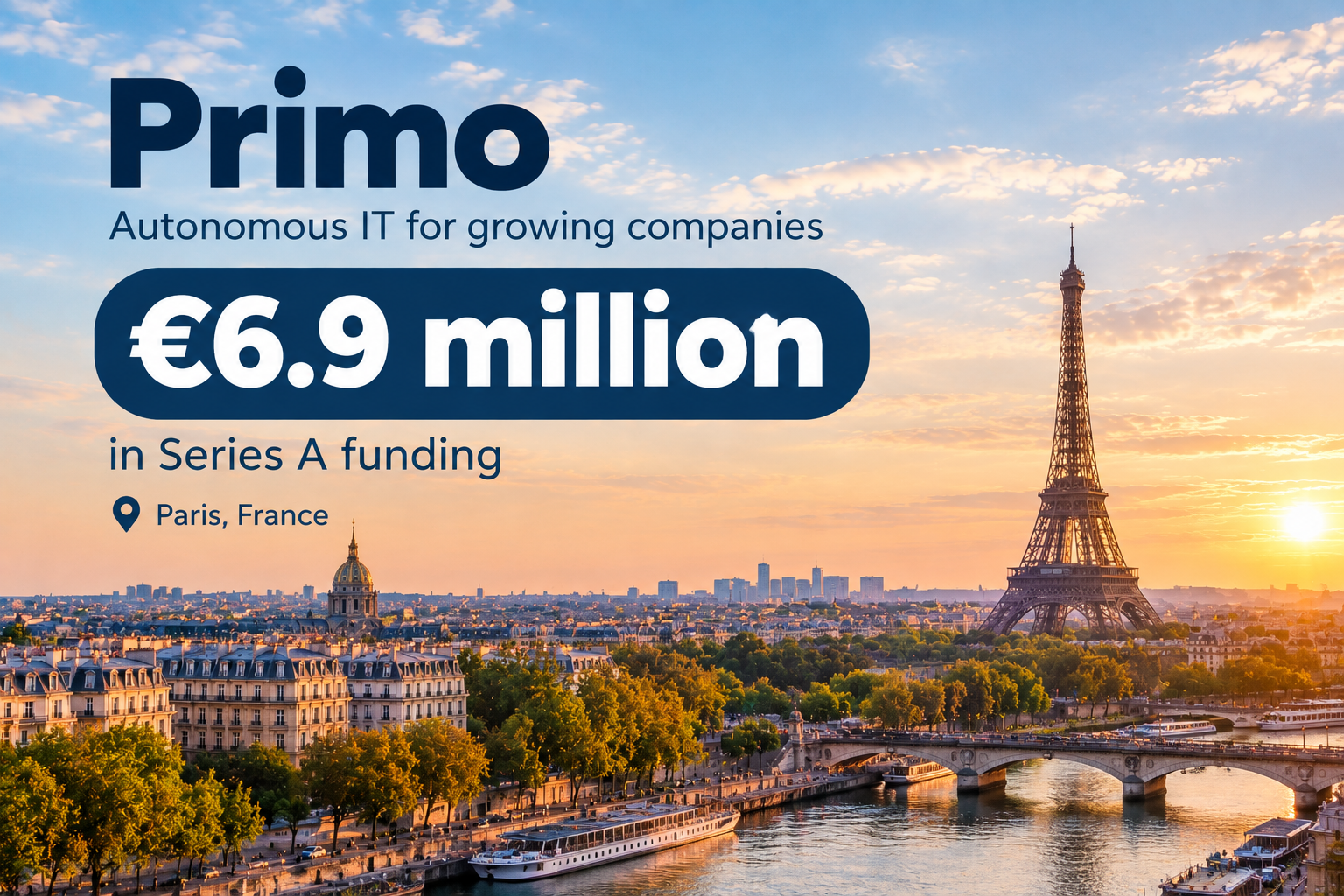
On 22 September 2026, Primo announced a new $8 million funding round, approximately €6.9 million, led by Headline and Global Founders Capital. Entrepreneurs Arthur Waller and Romain Niccoli also participated.
The two disclosed venture rounds represent approximately $11.4 million in announced private funding.
The new financing is intended to accelerate the development of Primo’s autonomous AI agents and support international expansion in Europe and the United States. The company’s AI agents are designed to execute processes such as IT support, hardware purchasing and compliance management within customer-defined rules and with traceability.
What Primo’s funding journey shows
Primo’s trajectory is an example of a startup using its initial capital to build an underlying platform before expanding into a larger technology opportunity.
The 2023 financing supported the creation of an all-in-one IT platform. By 2026, that infrastructure had become the foundation for a different proposition: AI agents that can act on the information and permissions already held within the platform.
For entrepreneurs, this highlights the importance of the assets built between funding rounds. A later financing round is not necessarily based only on a new feature. It can be based on years of product development, customer adoption, recurring revenue and the infrastructure needed to support a larger opportunity.
It also shows why funding should be connected to a specific business milestone. Primo’s 2026 financing is tied to expanding autonomous capabilities and international growth rather than simply increasing the size of the company.
For founders developing B2B software, the journey illustrates the importance of using early capital to create a strong operational foundation that can support subsequent products and financing stages.
Entrepreneurs who want to develop their own fundraising roadmap can find practical resources through the Fundingtrip courses.
About the author of this post

.
Sara Gavidia
Content Creator
Communications Manager & Content creator
LinkedIn
[email protected]
.
Hello! I’m Sara 👋🏻
I’m FundingTrip’s Content creator. I write posts about technology, funding and innovation. If you liked this one, subscribe to our newsletter to receive more updates!
Post reviewed by David Arias, funding expert.