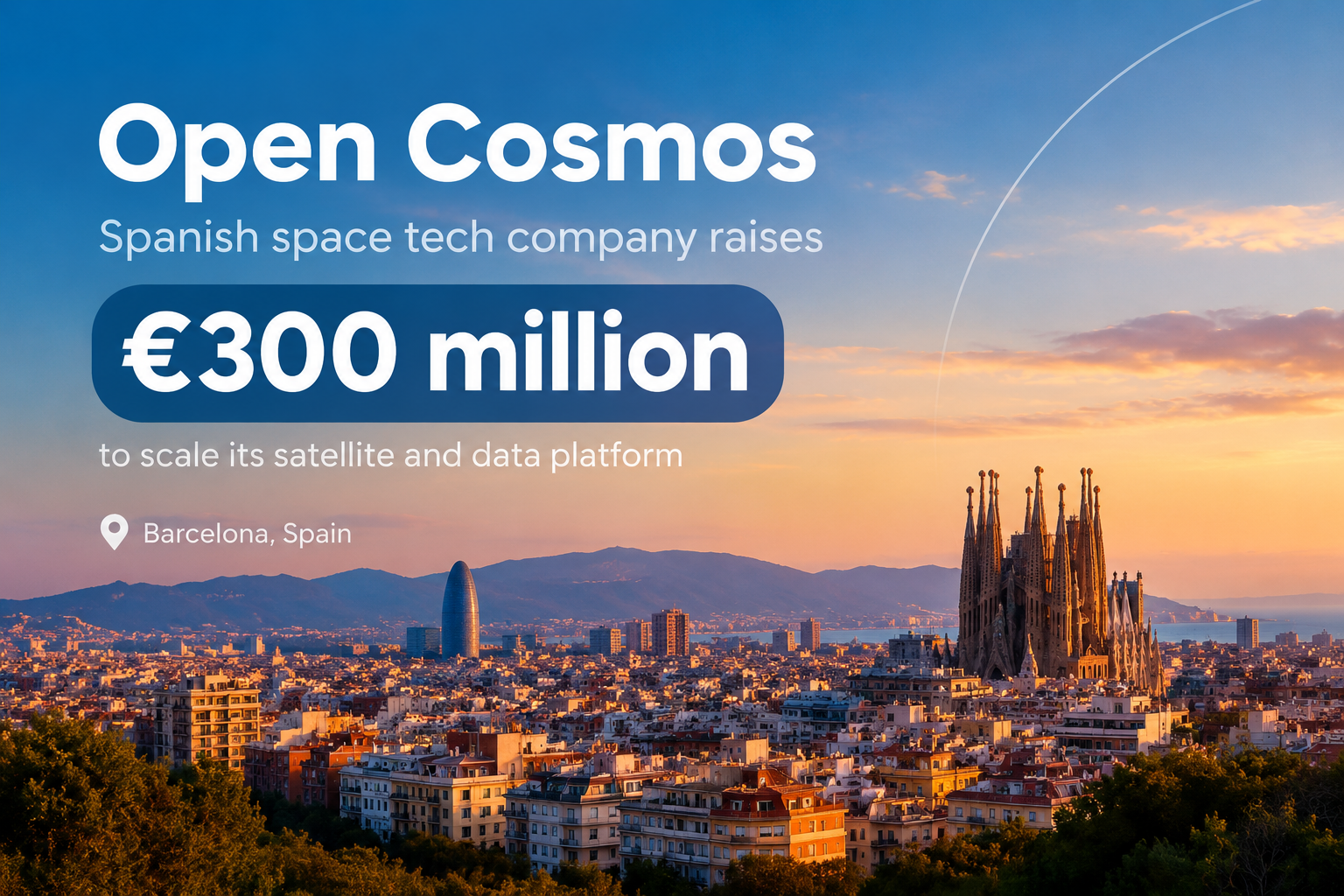
Open Cosmos is a Spanish space technology company founded in 2015 by Rafel Jordà Siquier. The company designs, builds and operates satellite missions, combining satellite manufacturing with launch, orbital operations, connectivity and data services. Its activities include OpenConstellation, ConnectedCosmos and DataCosmos, covering shared satellite infrastructure, secure connectivity and Earth-observation intelligence.
The company began with a relatively simple proposition: make access to space faster, more affordable and easier for organisations that could not traditionally develop their own satellite missions. Its first years were supported by commercial contracts and institutional programmes, including work with the European Space Agency and the UK government.
The business has since evolved considerably. Open Cosmos now operates manufacturing facilities in several European countries and is developing infrastructure designed to deliver satellite connectivity and Earth-observation information on a much larger scale.
This post covers:
- What Open Cosmos does and why its technology matters
- The company’s funding journey from its early years to September 2026
- Public and private financing behind its expansion
- What the funding journey shows for entrepreneurs
The funding journey
Open Cosmos’ early external financing included a $7 million Series A announced in 2018, led by BGF Ventures with LocalGlobe, Entrepreneur First, Taavet Hinrikus and Charlie Songhurst among the other participants. The company subsequently focused heavily on commercialisation and organic growth.
In September 2023, Open Cosmos announced a $50 million Series B, led by ETF Partners, Trill Impact and A&G. The company said that, before this round, it had raised only $7 million in external funding, reflecting a strategy centred on commercialisation and organic growth.
Public support also became an important part of the company’s industrial expansion. In November 2023, Open Cosmos received a £5 million UK Space Agency project through the Space Clusters and Infrastructure Fund to expand manufacturing and R&D capabilities.
In 2025, two investment vehicles of the Institut Català de Finances invested a combined €31 million in Open Cosmos. In August 2026, Avançsa, an entity wholly owned by the Government of Catalonia, approved another €4 million financing operation through its Innova Creixement programme.
Then came the major September milestone. On 14 September 2026, Open Cosmos announced €300 million in new funding. The round was led by European investors including Lightrock and ETF Partners, with participation from ICF, Entrepreneurs First, pension funds and other institutional and venture investors. A&G also confirmed that it participated through its equity investment vehicle.
The new capital is intended to increase satellite mass-manufacturing capacity and accelerate ConnectedCosmos, OpenConstellation and DataCosmos. The company says it can currently manufacture up to one satellite per day across its European facilities.
What Open Cosmos’ funding journey shows
Open Cosmos illustrates how a capital-intensive deep-tech company can use different types of financing at different stages. Early venture capital supported product development and commercial expansion. Later institutional investment supported international growth, while government-backed programmes helped finance industrial and R&D infrastructure.
For entrepreneurs, the important point is not simply the size of the September 2026 round. The company’s trajectory shows the value of building commercial evidence before pursuing very large financing rounds. Open Cosmos reported that it had achieved several years of profitable growth before its 2023 Series B, demonstrating that venture funding can come alongside a business model that is already generating commercial traction.
Its journey also demonstrates why founders should look beyond conventional venture capital. Grants, public investment, loans, institutional investors and equity financing can serve different purposes. For companies working on strategic technologies, identifying the right combination can be as important as identifying individual investors.
For entrepreneurs developing capital-intensive technologies, Open Cosmos provides an example of a long funding journey in which private capital and public support have accompanied the company from early commercialisation to large-scale industrial expansion.
What entrepreneurs can take from it
A funding strategy does not have to rely on one type of investor. Startups can build financing progressively, matching each source to a specific development stage: R&D, validation, manufacturing, market expansion or internationalisation.
The September 2026 Open Cosmos round shows what can happen when a company reaches a stage where investors are financing not only an idea or product, but a proven industrial platform with ambitions for much larger-scale deployment.
Funding is only one part of building that trajectory. Entrepreneurs who want to understand how to identify relevant opportunities, prepare for fundraising and navigate different financing options can explore the Fundingtrip courses, designed to help founders develop a more structured approach to startup funding.
About the author of this post

.
Sara Gavidia
Content Creator
Communications Manager & Content creator
LinkedIn
[email protected]
.
Hello! I’m Sara 👋🏻
I’m FundingTrip’s Content creator. I write posts about technology, funding and innovation. If you liked this one, subscribe to our newsletter to receive more updates!
Post reviewed by David Arias, funding expert.