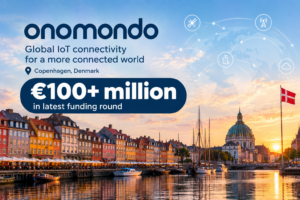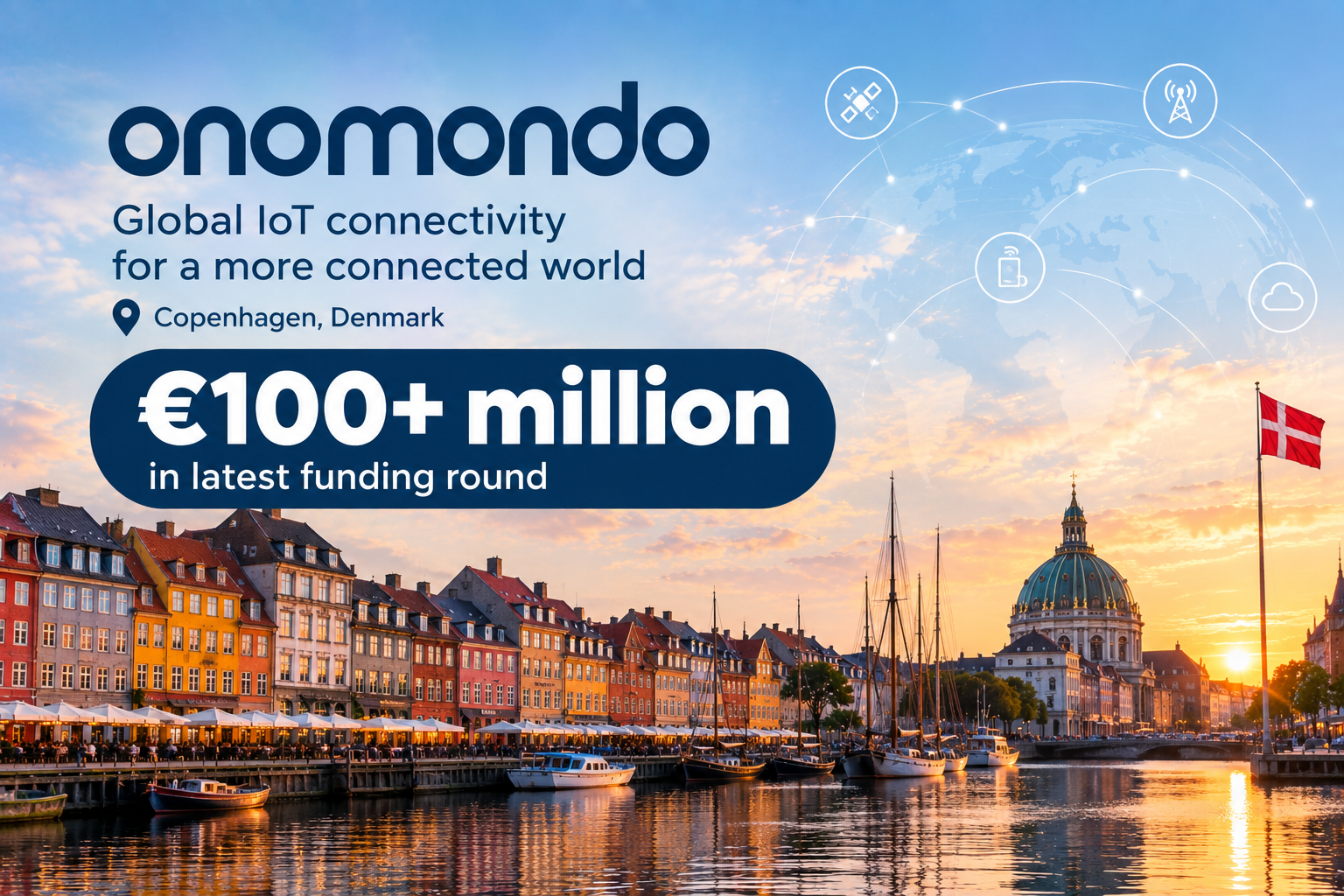
Copenhagen-based Onomondo has built its business around a problem that sits underneath the rapidly expanding Internet of Things: connecting physical devices reliably across countries, networks and operating environments.
The Danish company provides global IoT connectivity and infrastructure through its own technology stack, giving businesses greater control over the connection between devices, networks and cloud systems. By 2026, Onomondo’s technology was being used by more than 500 companies across more than 100 countries.
September 2026 marked a major change in the company’s ownership and financing structure. Rather than a conventional venture round, Onomondo announced a majority investment by Aspirity Partners involving more than €100 million in combined investment, while Denmark’s Export and Investment Fund (EIFO) increased its own investment.
What this article covers
- What Onomondo does and why its infrastructure matters
- Its progression from early investment to international scale
- The 2026 majority investment and EIFO’s continued involvement
- The combination of private and public-backed capital
- What the journey can teach entrepreneurs building infrastructure businesses
From connectivity provider to infrastructure platform
Onomondo’s proposition is broader than selling conventional mobile connectivity for connected devices. Its technology is designed to simplify the management of IoT deployments by bringing device, network and cloud connectivity together.
The company has developed a proprietary connectivity stack and access to nearly 700 networks worldwide. Its technology is used in applications ranging from logistics and automotive to energy and industrial operations.
The company has also developed SoftSIM technology, removing the need for traditional physical SIM cards in relevant IoT deployments. Its infrastructure can support public and private networks, allowing connected assets to move between different environments.
A significant example is its work with Maersk, where Onomondo’s technology supports connectivity across hundreds of vessels. This illustrates the type of infrastructure problem the company is targeting: devices increasingly need to remain connected while moving between countries, networks and physical environments.
The road to growth capital
Onomondo’s funding journey developed alongside the expansion of its commercial footprint.
In 2022, Verdane invested $21 million in the company in a growth investment led by the European investment firm. Existing investors including Maersk Growth, People Ventures and Denmark’s Growth Fund also participated.
The investment was designed to support international expansion, product development and team growth. At the time, Onomondo described itself as a scale-up that had already demonstrated strong customer and technology momentum.
The presence of Denmark’s public investment ecosystem has also been part of the company’s financing journey. EIFO, Denmark’s sovereign investment fund, has backed Onomondo since 2021 and remained involved as the company moved toward its next stage of growth.
September 2026: a new majority investor
On 30 September 2026, Onomondo announced that Aspirity Partners had agreed to acquire a majority stake in the company. The transaction represents a combined investment of more than €100 million, while EIFO is increasing its investment alongside the new majority owner.
EIFO reported the transaction as an investment of more than DKK 750 million into Onomondo, with Aspirity becoming the company’s new main shareholder.
The new capital is intended to accelerate international expansion and continue development of Onomondo’s proprietary global infrastructure, while keeping the company anchored in Denmark.
The transaction is therefore an important change in the company’s financing journey. After using venture and growth capital to build the platform, Onomondo is entering a phase supported by a large-scale private equity investor and continued participation from a Danish public investment institution.
What Onomondo’s funding journey shows
Infrastructure businesses often require patient capital.
Building a global network is fundamentally different from launching a lightweight software product and requires significant technology, engineering and commercial investment.
Growth capital can follow proven market demand.
Onomondo’s 2022 investment came after the company had developed its technology and established customers across different industries.
Public and private capital can work alongside each other.
EIFO’s continued participation provides a Danish institutional anchor while private investors support international scaling.
Strategic ownership can mark a new stage.
The 2026 transaction gives Onomondo a different type of capital base from its earlier venture financing.
International scale can make infrastructure companies particularly attractive.
More than 500 customers and operations spanning over 100 countries demonstrate the global nature of the market Onomondo is targeting.
What this means for entrepreneurs
Onomondo offers a useful example for founders building infrastructure, connectivity or other technology businesses where commercial expansion requires substantial upfront investment.
The company’s journey suggests that entrepreneurs should think about capital not only in terms of the amount raised, but also in terms of the type of investor needed at each stage. Early investors can help validate a business model, growth investors can accelerate internationalisation and later-stage investors can provide the capital and organisational support required for a much larger expansion.
It also shows the value of maintaining institutional relationships over time. EIFO’s continued involvement means that public-backed capital did not simply provide an early injection of funding; it remained part of the company’s financing ecosystem as Onomondo matured.
For founders in similar situations, the lesson is to build a funding strategy that evolves with the business. Fundingtrip’s funding courses can help entrepreneurs understand these financing stages, prepare stronger funding strategies and identify the opportunities most relevant to their company’s development.
About the author of this post

.
Sara Gavidia
Content Creator
Communications Manager & Content creator
LinkedIn
[email protected]
.
Hello! I’m Sara 👋🏻
I’m FundingTrip’s Content creator. I write posts about technology, funding and innovation. If you liked this one, subscribe to our newsletter to receive more updates!
Post reviewed by David Arias, funding expert.