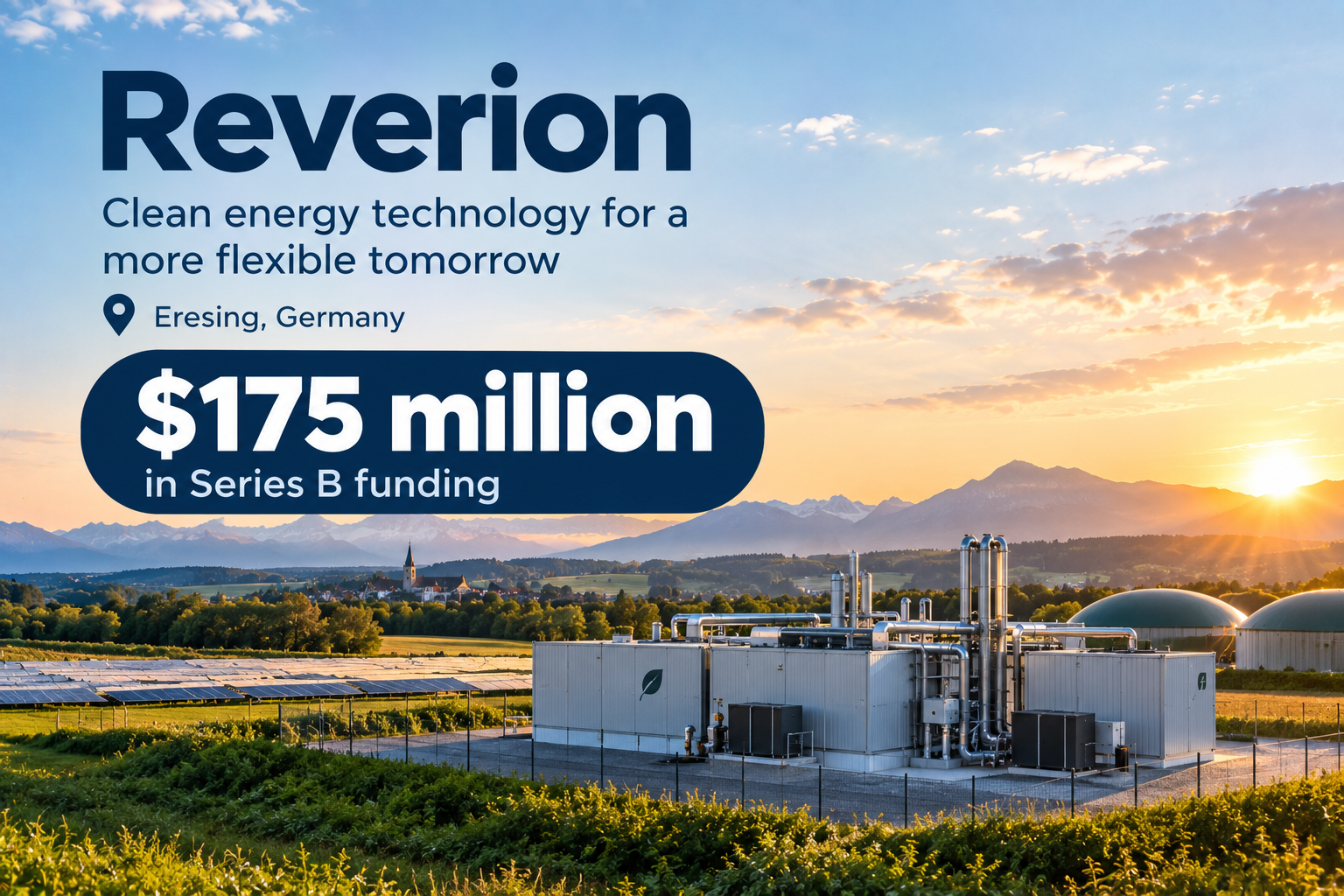
Reverion, the German energy technology company based in Eresing, Bavaria, is developing reversible solid-oxide fuel-cell power plants designed to combine efficient electricity generation, energy storage and the possibility of carbon-negative operation. Its technology is aimed particularly at biogas applications, while also addressing the growing need for flexible power generation as renewable energy and electricity demand increase.
In September 2026, Reverion reached a new stage in its development with a $175 million Series B, one of the largest financing rounds announced by a German climate-tech company that year. The investment is intended to move the company from technology and pre-series production toward significantly larger industrial manufacturing.
What this article covers:
- How Reverion’s technology addresses renewable energy and grid flexibility
- The company’s progression from seed funding to its 2026 Series B
- The role of public and private financing in its development
- What the funding journey shows about scaling deep-tech companies
- Lessons for entrepreneurs developing capital-intensive technologies
From research to commercial technology
Reverion originated as a spin-off of the Technical University of Munich. Its technology uses reversible solid-oxide cells to generate electricity from renewable gases and, when operating in reverse, convert surplus renewable electricity into renewable gas or hydrogen.
The company’s proposition is particularly relevant to energy systems in which electricity from wind and solar is not continuously available. Reverion’s plants can operate flexibly and, when using biogas, can capture the carbon dioxide generated during electricity production, enabling carbon-negative operation.
The technology has also been designed with existing energy infrastructure in mind. This allows Reverion to address the challenge of balancing renewable electricity generation with demand without relying exclusively on conventional fossil-fuel generation or short-duration batteries.
A funding journey built around technological milestones
Reverion’s financing history shows a gradual progression from publicly supported research and early venture capital toward large private investment.
In 2022, the company announced more than €7 million in seed funding. This financing followed earlier support from Germany’s Federal Ministry for Economic Affairs and Climate Action, the European Social Fund and prize money from the XPRIZE Carbon Removal Challenge.
In 2023, Reverion raised another €8.5 million to accelerate production of its 100 kW and 500 kW plants. At the same time, the company reported €12 million in research capital, supporting further development of its technology. The same year, Reverion received €3 million from SPRIND for long-duration energy storage.
The next major step came in 2024, when Reverion announced a $62 million Series A, including non-dilutive funding. Energy Impact Partners led the round, with Honda and the European Innovation Council Fund among the participants, alongside existing investors including Extantia Capital, UVC Partners, Green Generation Fund, Doral Energy-Tech Ventures and Possible Ventures.
In 2025, Reverion also received €19.5 million from the European Innovation Fund for the RESILIENCE project, aimed at scaling production of its reversible power plants.
The September 2026 Series B therefore represents more than another fundraising milestone. It follows several years of combining venture investment with European and German public support to move the technology toward industrial deployment.
September 2026: $175 million to scale production
On 29 September 2026, Reverion announced that it had closed a $175 million Series B led by Kembara, a European growth fund focused on deep-tech and climate technologies.
New investors include Allianz, KfW Capital, Aurum Impact and Carbon Equity, while existing investors including Extantia, Energy Impact Partners, UVC Partners, the EIC Fund, alfa8 and Possible Ventures also participated.
The largest part of the new capital is intended for a new German production site with planned annual manufacturing capacity of 250 MW. Reverion expects the facility to increase production capacity tenfold and potentially create up to 800 jobs.
The company has also reported an electrical efficiency of up to 74.2% in live customer operation for its first pre-series units, strengthening the commercial case for moving into larger-scale production.
What Reverion’s funding journey shows
Public funding can reduce the risk of deep-tech development.
Research grants and innovation programmes helped Reverion develop and validate technology before the company needed to finance large-scale manufacturing.
Private capital becomes increasingly important as hardware moves toward production.
Venture funding supported the transition from research to commercialisation, while later-stage capital is now being used for industrial infrastructure.
Technical progress needs to be matched by commercial evidence.
Reverion had already secured substantial customer pre-orders before its Series A, demonstrating market demand alongside technological development.
Different investors can contribute at different stages.
Early climate-tech investors, strategic investors, public institutions and later-stage growth capital have each played different roles.
Capital intensity changes the fundraising strategy.
For companies building physical infrastructure, reaching the market may require considerably more capital than developing software alone.
For entrepreneurs developing energy, climate or other capital-intensive technologies, Reverion’s journey illustrates the importance of building a financing roadmap rather than relying on a single source of capital. Grants can support technical validation, venture capital can finance commercial development and later growth investors can help fund industrial expansion.
What this means for similar entrepreneurs
The key lesson is that fundraising should follow the technology’s development curve. A company does not necessarily need to seek its largest possible round at the beginning. Instead, each financing stage can be connected to a measurable milestone: technical validation, pilot deployment, customer traction, production readiness and finally industrial scale.
Reverion’s progression also demonstrates the value of combining public and private financing. For deep-tech entrepreneurs, public innovation programmes can make a project more investable by reducing technological risk before a major equity round is required.
Funding is most powerful when it is tied to a clear transition in the business. Reverion’s latest round is aimed not simply at continuing research, but at building the manufacturing capacity required to turn an established technology into a large-scale business.
For entrepreneurs navigating a similar path, understanding which funding instruments fit each stage can make the difference between an interesting technology and a scalable company. Fundingtrip can help founders develop that understanding and identify suitable funding opportunities through its funding courses.
About the author of this post

.
Sara Gavidia
Content Creator
Communications Manager & Content creator
LinkedIn
[email protected]
.
Hello! I’m Sara 👋🏻
I’m FundingTrip’s Content creator. I write posts about technology, funding and innovation. If you liked this one, subscribe to our newsletter to receive more updates!
Post reviewed by David Arias, funding expert.