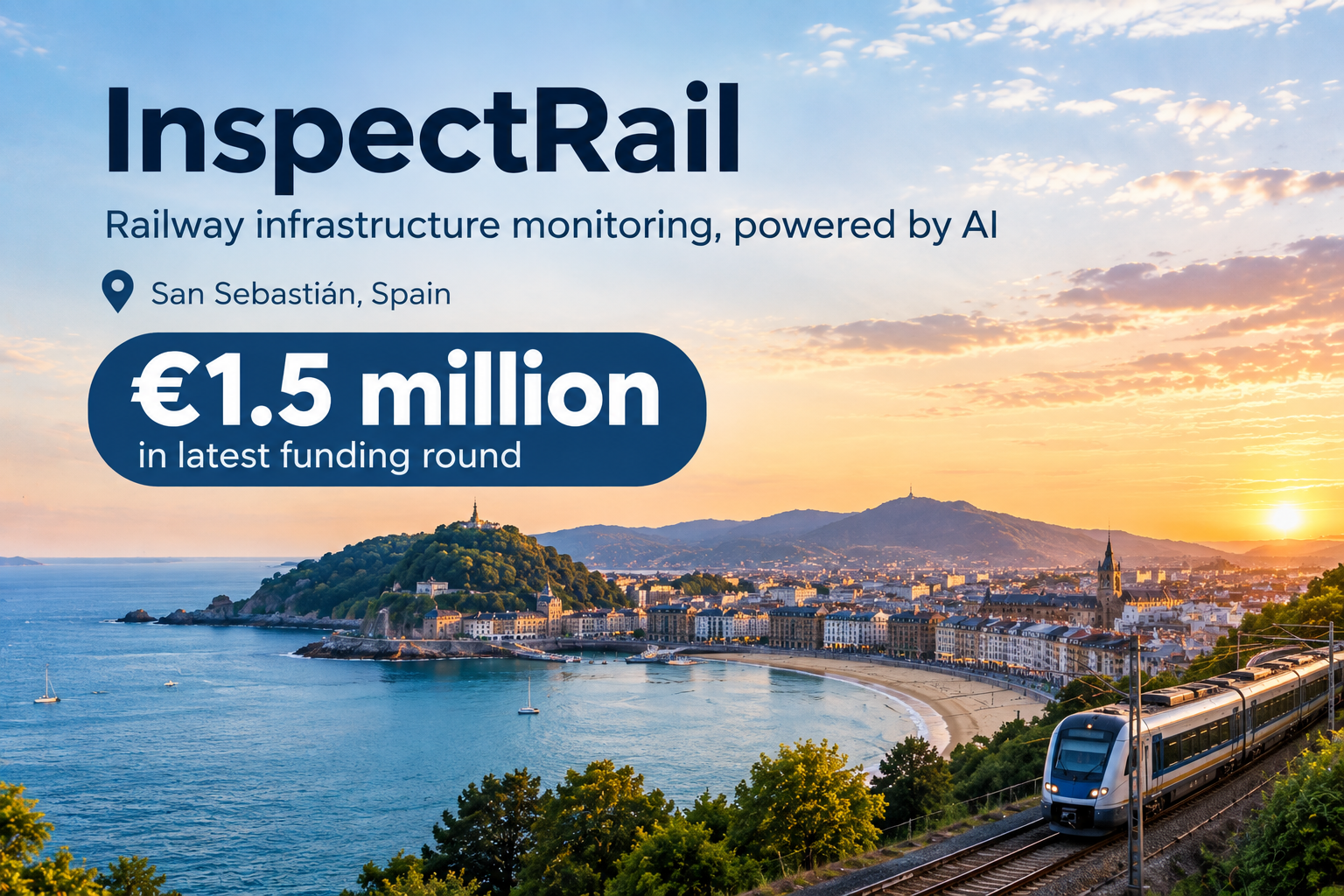
InspectRail is a San Sebastián-based railway technology startup created in 2023 as a spin-off of the Ceit technology centre. The company develops technology for monitoring railway infrastructure using sensors, computer vision and artificial intelligence. Its approach turns trains already operating in normal service into mobile inspection platforms, collecting information about tracks, catenary, communications and other infrastructure conditions without requiring dedicated inspection trains.
This model is designed to help railway operators identify problems earlier, improve maintenance planning and reduce the need for costly and disruptive manual inspections.
What this article covers
- What InspectRail does and how its technology works
- Its development from a Ceit spin-off to a funded railway technology company
- The €1.5 million financing announced in September 2026
- The combination of equity and long-term debt
- What InspectRail’s funding journey can mean for other deep-tech entrepreneurs
From research to railway operations
InspectRail was launched by Ceit in 2023 with the backing of the Basque Government and SPRI through the Basque Tek Ventures initiative. Its technology addresses a fundamental challenge in railway maintenance: obtaining detailed and continuous information about infrastructure without relying exclusively on specialised inspection vehicles or manual checks.
The company’s system can assess elements including track geometry and quality, rail wear, wireless communications, the interaction between pantographs and overhead power lines, signalling and vegetation. The information can then support maintenance decisions and help operators detect potential problems earlier.
This focus has positioned InspectRail within the broader digitalisation of railway infrastructure. In 2025, the company was recognised as the startup with the greatest potential and impact in the Basque Country in the regional EmprendeXXI awards, selected from 59 applications.
September 2026: €1.5 million to scale the business
In September 2026, InspectRail announced a €1.5 million financing round combining equity and long-term debt.
The equity component was backed by Gestión de Capital Riesgo del País Vasco, part of the SPRI Group, through Basque Tek Ventures, together with EASO Ventures, Pinama Capital and EONIQ Fund.
The financing also included long-term debt from Deeptek Gipuzkoa Fundazioa, Elkargi, Fomento San Sebastián, CaixaBank DayOne and Rural Kutxa.
Rather than using the money only for technological research, InspectRail plans to use the new financing to strengthen deployment capacity, continue developing its technology, increase its workforce and accelerate entry into new markets, particularly among European railway operators.
The timing of the round coincided with the company’s participation in InnoTrans 2026 in Berlin, one of the major international events for the railway industry.
The role of public and private funding
InspectRail’s funding history illustrates the interaction between a technology spin-off and the regional innovation ecosystem.
From its creation, the company benefited from the involvement of Ceit and public-backed Basque Tek Ventures. The September 2026 financing then combined public-backed equity with private investment and debt financing.
The structure is particularly relevant for capital-intensive technologies. A company developing infrastructure technology may need capital to develop the product, but it may also need debt or other forms of financing to support deployment once the technology has reached a more advanced stage.
For InspectRail, the September round therefore represents a transition from developing and validating the technology towards increasing its commercial deployment.
What InspectRail’s funding journey shows
InspectRail demonstrates how a deep-tech company can build a financing strategy around the gradual maturation of its technology.
The company started from research developed within a technology centre and moved into a standalone business focused on a clearly defined industrial problem. Recognition through the EmprendeXXI programme provided additional visibility within the entrepreneurial ecosystem, while the September 2026 financing brings together several types of capital.
For entrepreneurs developing industrial or infrastructure technologies, the journey highlights the importance of matching financing with business maturity. Equity can support product development and growth, while debt can become relevant when the company needs additional capital for deployment and expansion.
It also shows the value of an ecosystem around a startup. Technology centres, public investment vehicles, private investors, financial institutions and sector-specific networks can each contribute at different points in the company’s development.
What this means for entrepreneurs
Founders working on deep-tech solutions should not necessarily approach funding as a single fundraising event. A more structured approach can involve identifying which milestones require equity, which may qualify for public support and which can eventually be financed through debt or commercial revenues.
InspectRail’s journey shows how a technology developed within a research environment can progressively become a business capable of attracting several types of financing.
For entrepreneurs looking to understand how to identify funding opportunities, prepare their fundraising strategy and navigate different financing instruments, Fundingtrip’s funding courses can provide practical guidance for building that roadmap.
About the author of this post

.
Sara Gavidia
Content Creator
Communications Manager & Content creator
LinkedIn
[email protected]
.
Hello! I’m Sara 👋🏻
I’m FundingTrip’s Content creator. I write posts about technology, funding and innovation. If you liked this one, subscribe to our newsletter to receive more updates!
Post reviewed by David Arias, funding expert.